

If you want to move into ESG analysis, impact investing, or sustainable portfolio management, the fastest credible path is Verdantinstitute's structured learning tracks combined with its CPD-tracked completion certificates. The curriculum is built for finance professionals, not general audiences, which means you spend your study hours on ESG integration in valuation, climate risk modeling, and impact measurement rather than introductory definitions you already know.
The reason this route works with employers is practical: Verdantinstitute pairs applied project work with CPD tracking and verifiable credentials, giving hiring managers something concrete to evaluate. A certificate alone rarely moves a resume to the top of the pile. Applied deliverables do.
Pro Tip: If you already have a corporate finance or valuation background, skip the foundational certificate and go straight to a targeted applied module such as portfolio decarbonization or ESG data and ratings. If you are newer to finance, start with the Foundations track to build the analytical base that makes every ESG concept stick.
Table of Contents
- What kinds of sustainable investing courses and certificates exist?
- Why do sustainable investing credentials actually advance your career?
- What will you actually learn? Core modules and technical skills
- Which professionals benefit most, and what should you expect to commit?
- How do the major credential paths compare?
- How do you pick the right course for your goals?
- How do you turn coursework into actual career gains?
- What does a Verdantinstitute learning path actually look like?
- What are your immediate next steps?
- Key Takeaways
- Why the credential conversation in ESG misses the point
- Verdantinstitute: structured ESG training built for finance careers
- Useful sources and further reading
What kinds of sustainable investing courses and certificates exist?
The market for sustainable finance certifications has expanded fast, and the formats vary enough that picking the wrong one costs you both time and money. Here is a quick map:
- Professional certificates (self-paced, exam-based): Designed for working professionals who need a globally recognized credential. The CFA Institute Sustainable Investing Certificate is the benchmark example, recommending roughly 100 hours of study and awarding CPD credits plus a digital badge on completion.
- Executive education programs (cohort-based, short-form): Typically several weeks, delivered by university business schools. Yale School of Management's Sustainable Finance and Investment online program and HBS Online's Sustainable Investing course both follow this model, combining structured modules with live cohort interaction.
- University continuing-education courses (credit or non-credit): Longer, more academic, and often tied to a degree pathway. Tufts University's Impact and Sustainable Investing certificate program is one example.
- Subscription-based learning platforms: Ongoing access to a full course library with CPD tracking and certificates. Verdantinstitute operates in this category, with 16 courses and over 160 lessons across tracks from foundational ESG to advanced transition finance.
- Microcredentials and beginner bootcamps: Short, practical, and low-cost. Courses like Ethical Investing 101 focus on portfolio-level decision rules for individual investors and beginners, covering ETFs and fund analysis with practical checklists. These build awareness but rarely satisfy employer credentialing requirements.
Each format serves a different career stage. The right one depends on how much time you have, what your employer will recognize, and how deep you need to go technically.
Why do sustainable investing credentials actually advance your career?
Employers reward demonstrable, applied skills. Completing a course matters less than being able to walk into an interview and explain how you adjusted a DCF model for stranded-asset risk or built an impact measurement framework from scratch.
Structured online learning combined with interactive exercises correlates with increased professional confidence and measurable career advancement for finance professionals, according to HBS Online's pedagogical research. That correlation holds specifically when applied exercises are included, not just video lectures. The mechanism is straightforward: applied work forces you to make decisions with incomplete ESG data, which is exactly what the job requires.
Credential signals that raise employer confidence include institutional recognition, CPD credits, published syllabi, and demonstrable alumni outcomes. Certificates that publish CPD credits and provide verified digital badges are easier for hiring managers to validate at a glance.
The CFA Institute updates its Sustainable Investing Certificate curriculum annually to reflect new ESG regulations, data standards, and market practice. That annual revision cycle matters because ESG frameworks shift quickly, and a credential built on 2021 taxonomy guidance looks dated to a 2026 hiring manager.
For salary context, the sustainable finance salary premium over conventional finance roles has grown as demand for ESG-literate analysts outpaces supply. Credentials that signal applied competence, not just awareness, capture most of that premium.

What will you actually learn? Core modules and technical skills
A well-designed sustainable investing curriculum covers six core areas. You should expect all of them in any program worth your time:
- ESG integration in valuation: Adjusting financial models for material ESG factors, including governance risk discounts and environmental liability estimates.
- Climate risk and scenario analysis: Applying TCFD-aligned frameworks to assess physical and transition risks in a portfolio.
- Impact measurement and reporting: Building impact frameworks, selecting KPIs, and aligning with standards like IRIS+ or the Impact Management Project.
- Stewardship and shareholder engagement: Proxy voting, engagement strategies, and the mechanics of active ownership.
- ESG data and third-party ratings: Understanding how MSCI, Sustainalytics, and Bloomberg ESG scores are constructed, where they diverge, and how to use them critically. ESG disclosure quality directly affects how reliable these ratings are.
- Portfolio decarbonization techniques: Carbon footprinting, net-zero alignment strategies, and Paris-aligned benchmark construction.
HBS Online structures its Sustainable Investing course in modular five-hour segments across public equities, private markets, impact measurement, climate risk, and theories of change, which gives a useful benchmark for how long each topic genuinely takes to cover at a professional level.
The deliverables employers care about most are investment memos with ESG adjustments, impact measurement frameworks, and portfolio recommendations with documented rationale. PRI Academy emphasizes applied frameworks and practical exercises precisely because practitioners need to operationalize responsible investment principles in daily decisions, not just describe them.
One prerequisite note: foundational finance skills remain essential before you can apply ESG adjustments credibly. Comfort with corporate finance, accounting, and valuation is the floor. Without it, ESG integration becomes a labeling exercise rather than an analytical one.
Which professionals benefit most, and what should you expect to commit?
| Candidate Profile | Prerequisites | Recommended Format | Time Commitment |
|---|---|---|---|
| Early-career analyst | Basic finance coursework | Foundational certificate or subscription platform | several hours per week over multiple weeks |
| Portfolio manager expanding into ESG | Strong valuation and portfolio theory | Applied executive course or advanced subscription track | several hours per week over a number of weeks |
| Risk and compliance professional | Regulatory and financial reporting basics | Professional certificate (CFA Institute or equivalent) | a significant amount of self-paced study |
| Wealth advisor adding ESG mandates | Client portfolio management experience | Short executive program or targeted microcredential | a few hours weekly for several weeks |
| Career changer with finance basics | Undergraduate finance or accounting | Foundational track + applied module sequence | a substantial weekly time commitment over multiple weeks |
The sustainable finance career landscape now spans roles from ESG analyst and impact investment associate to climate risk officer and stewardship manager. Your entry point into coursework should map to the specific role you are targeting, not just to a general interest in sustainability.
For students, the ESG course selection guide for finance majors offers a more granular breakdown of which modules to prioritize by major and intended career track.
How do the major credential paths compare?
| Credential Type | Time to Complete | Cost Shape | CPD Credits | Technical Depth | Applied Project | Networking |
|---|---|---|---|---|---|---|
| Professional certificate (e.g., CFA Institute) | ~100 hrs self-paced | One-time fee | Yes, digital badge | High | Limited | Alumni community |
| Executive education (e.g., Yale, HBS Online) | several weeks | Program fee per cohort | Varies by program | Medium–High | Case-based | Live cohort |
| Subscription platform (e.g., Verdantinstitute) | Flexible, ongoing | Monthly subscription | Yes, CPD tracking | High, modular | Applied modules | Peer community |
| University continuing-ed | 3–6 months | Per-course or program fee | Sometimes | Medium | Varies | Campus network |
| Beginner bootcamp/microcredential | 1–4 weeks | Low, often one-time | Rarely | Low–Medium | Minimal | Minimal |
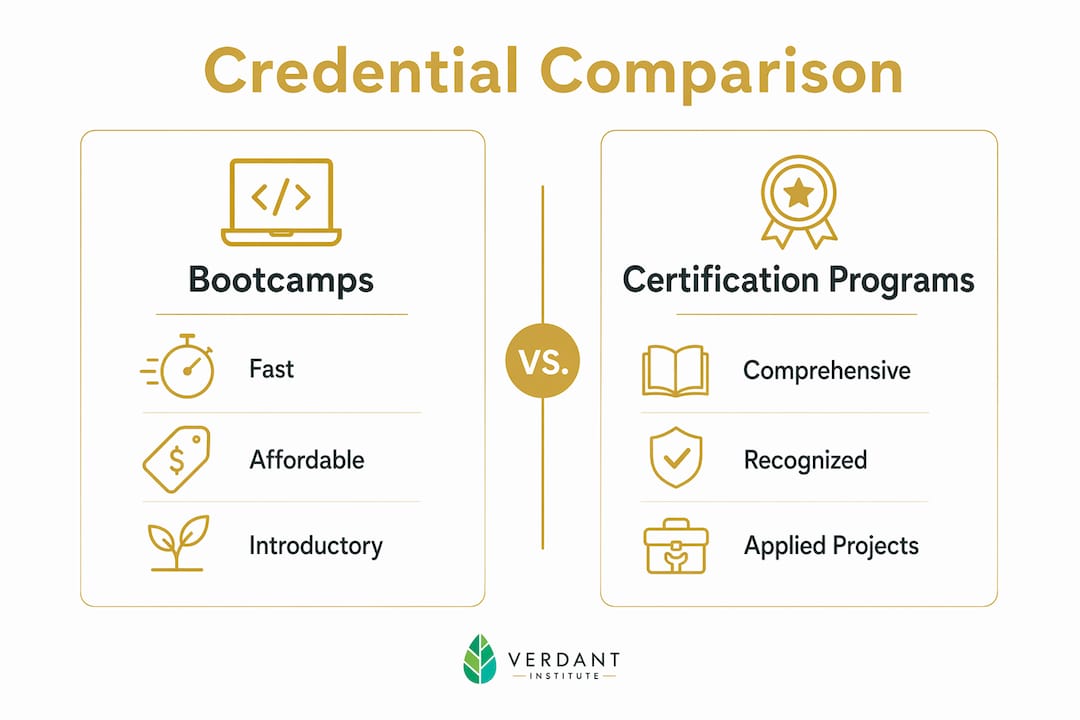
The trade-off is essentially speed versus rigor versus employer recognition. A beginner bootcamp gets you oriented in days but carries little weight in a hiring conversation. A professional certificate like the CFA Institute's takes longer but lands with institutional credibility. A subscription platform like Verdantinstitute sits in a practical middle ground: you move at your own pace, build CPD hours continuously, and generate applied deliverables across multiple modules rather than a single credential event.
The credibility signals to check in any program: an updated syllabus (look for annual revision dates), published CPD credit values, institutional or industry endorsements, and accessible alumni outcome data. Programs that hide their syllabus or cannot point to graduate career outcomes are worth treating with skepticism.
How do you pick the right course for your goals?
Start with the role, not the credential. Identify the two or three specific skills that are blocking you from the position you want, then find the program that addresses those directly.
- Define your target role first. ESG analyst, impact investment associate, climate risk manager, and stewardship officer each require a different technical emphasis. Map the job description to the curriculum before you enroll.
- Audit your current skills. The sustainable finance skills checklist is a useful starting point for identifying gaps between your current competencies and employer expectations.
- Check the syllabus for applied deliverables. Does the program require you to build a financial model, write an investment memo, or construct an impact framework? If the answer is no, the credential will be harder to defend in an interview.
- Confirm CPD credit value and badge verifiability. Ask the provider directly: how many CPD hours does this credential represent, and how does an employer verify it?
- Assess the cost-to-ROI ratio. A $58/month subscription that produces three applied deliverables and a CPD-tracked certificate over 10 weeks compares favorably to a multi-thousand-dollar cohort program that produces a single completion certificate.
- Ask about curriculum update frequency. ESG regulations and data standards shift fast. A program that last updated its syllabus in 2022 may teach you frameworks that are already obsolete.
- Questions to ask providers before enrolling: When was the curriculum last updated? What deliverables will I produce? How do employers verify the credential? Are CPD hours published and recognized by a professional body?
How do you turn coursework into actual career gains?
Completing a course is the starting point, not the finish line. The professionals who see the fastest career movement are the ones who convert coursework into tangible evidence before they update their resume.
Build an applied deliverable during the course, not after. Write a short investment memo that integrates ESG adjustments into a real company's valuation. Create a one-page impact measurement example using a publicly available dataset. These are the artifacts that make a hiring conversation concrete. Employers look for proof of applied work: case studies, investment memos, and evidence of impact measurement, not only course completion certificates.

For resume and LinkedIn, translate course outcomes into skill-specific bullets. Instead of "Completed ESG certificate," write "Adjusted DCF model for TCFD-aligned climate risk scenarios; produced portfolio decarbonization recommendation for a mid-cap industrial holding." That specificity signals job-readiness in a way that a credential name alone does not.
CPD credits serve a dual purpose: they satisfy professional development requirements for bodies like the CFA Institute, and they give you a documented, employer-legible record of ongoing learning. Log them as you go. On LinkedIn, add the digital badge to your credentials section and link the issuing institution so hiring managers can verify it in seconds.
Internally, the fastest path to promotion often runs through a visible workplace project. Propose an ESG integration pilot for a portfolio segment, volunteer to lead a stewardship engagement review, or draft a climate risk disclosure memo for your team. Coursework gives you the framework; the internal project gives you the proof.
What does a Verdantinstitute learning path actually look like?
Verdantinstitute structures its curriculum across four tracks, each designed to build on the previous one rather than repeat it.
| Learning Milestone | Track | Expected Hours | Outcome |
|---|---|---|---|
| ESG fundamentals and frameworks | Foundations | 10 hrs | Foundations certificate, CPD hours logged |
| ESG integration in equity research | Deep Dive: ESG in Valuation | — | Module certificate, applied model deliverable |
| Climate risk and scenario analysis | Deep Dive: Climate Risk | — | Module certificate, TCFD-aligned case study |
| Portfolio decarbonization and net-zero | Advanced Practice | 10 hrs | Advanced certificate, portfolio recommendation |
| Full track completion | All tracks | — | CPD-tracked credential, completion certificate |
The platform's 16 courses and over 160 lessons are accessible on a monthly subscription, so you can move through one track intensively or spread the work across several months while maintaining CPD continuity. Each module produces a deliverable, not just a quiz score, which is the design choice that separates Verdantinstitute from passive video platforms.
Career outcomes from this kind of structured, applied pathway tend to follow a recognizable pattern: learners who complete the full track and build a portfolio of deliverables report moving into ESG analyst, sustainable portfolio associate, and impact investment roles within one to two hiring cycles.
What are your immediate next steps?
The recommendation is straightforward: start with a credential that matches your current finance skill level, build at least one applied deliverable during the course, and have that deliverable ready before your next job application or internal promotion conversation.
- This week: choose your entry point. If you have a solid finance background, begin with Verdantinstitute's Deep Dive tracks. If you need to build the analytical foundation first, start with the Foundations track. Either way, subscribe and complete the first module before the week is out.
- Within 30 days: request employer training funding. Many finance employers cover professional development costs for CPD-tracked credentials. Frame the request around the specific role competency you are building, not the course name.
- Over the next 4–6 weeks: run an applied project. Use the frameworks from your first completed module on a real portfolio position, a public company, or a hypothetical case. Document the methodology and output. That document is your first ESG portfolio artifact.
Key Takeaways
Sustainable investing credentials advance careers fastest when they combine CPD-tracked certificates with applied deliverables that hiring managers can evaluate directly.
| Point | Details |
|---|---|
| Start with your target role | Identify the two or three skill gaps blocking your next role before choosing a program. |
| Applied deliverables beat certificates alone | Investment memos, ESG-adjusted models, and impact frameworks are what hiring managers evaluate in interviews. |
| CPD credits and digital badges matter | Verifiable credentials that publish CPD hours are easier for employers to validate and recognize. |
| Curriculum freshness is a credibility signal | Programs that update syllabi annually reflect current ESG regulations and data standards. |
| Verdantinstitute's structured tracks | Offer CPD tracking, applied module deliverables, and completion certificates from $58/month for professionals. |
Why the credential conversation in ESG misses the point
The debate in sustainable finance education tends to fixate on which certificate carries the most brand recognition. That is the wrong question for most finance professionals. The right question is: what can you do after the course that you could not do before?
Most credential conversations treat ESG education as a signaling exercise, a line on a resume that tells a hiring manager you are aware of the topic. But awareness is not scarce. What is scarce is the ability to sit down with a set of ESG data, a financial model, and a portfolio mandate and produce something defensible. That skill comes from applied work, not from passing a multiple-choice exam.
The programs worth your time are the ones that force you to make decisions with imperfect data, document your reasoning, and produce an artifact you would be willing to show in an interview. The credential is the proof of completion. The deliverable is the proof of competence. You need both, but only one of them is hard to fake.
Verdantinstitute: structured ESG training built for finance careers
Finance professionals who want applied ESG skills without committing to a semester-long university program or a multi-thousand-dollar cohort fee have a practical alternative in Verdantinstitute. The platform gives you access to 16 courses and over 160 lessons across foundational, deep-dive, and advanced practice tracks, all with CPD tracking and completion certificates built in.
The subscription model means you pay for access as long as you need it: monthly subscription fees for students and professionals respectively. Institutional licensing is available for finance teams and universities that want to train cohorts. Every track produces applied deliverables, not just quiz completions, so you leave with a portfolio of work that supports your next career move.
Start your first module this week and have your first CPD-tracked certificate within 30 days.
Useful sources and further reading
- CFA Institute Sustainable Investing Certificate: Curriculum overview, CPD credit details, and digital badge information for the globally recognized professional credential.
- HBS Online Sustainable Investing Course: Module-level breakdown of an executive-education format covering public equities, private markets, climate risk, and impact measurement.
- PRI Academy Responsible Investment Training: Applied responsible investment modules, climate risk tracks, and private-markets ESG courses for practitioners.
- Yale School of Management: Sustainable Finance and Investment: Six-week online program covering ESG data, asset pricing, portfolio management, and impact metrics.
- FIU Institute of Environment: Environmental Finance and Risk Management: Academic program applying financial modeling and data analytics to environmental risk and resilience strategies.
- Verdantinstitute Blog: Sustainable Finance Career Guide: Overview of roles, career paths, and credentials in sustainable finance for 2026.