

Why stakeholder theory is fundamental to ESG principles
Stakeholder theory is the conceptual backbone of ESG. Without it, environmental, social, and governance metrics are just a compliance checklist. With it, they become a system for creating durable corporate value by accounting for every group that affects or is affected by a firm's operations.
The core argument is straightforward: corporations do not exist in isolation. Employees, customers, suppliers, communities, regulators, and investors all have legitimate claims on how a business behaves. ESG's triple bottom line, covering environmental stewardship, social responsibility, and governance integrity, maps almost perfectly onto those claims. Stakeholder theory provides the ethical and practical rationale for why those claims deserve a seat at the table.
Stakeholder theory offers a practical, efficient, and ethical way to manage organizations in complex and turbulent environments. Stakeholders treated well tend to reciprocate: customers buy more, employees stay loyal even during downturns, and communities provide regulatory goodwill. That reciprocity is not charity. It is a mechanism for competitive advantage.
Key elements linking stakeholder theory to ESG outcomes:
- Shared value creation: Addressing stakeholder needs across environmental, social, and governance dimensions generates returns that pure shareholder focus misses.
- Risk mitigation: Proactive stakeholder engagement reduces reputational, regulatory, and operational exposure before crises emerge.
- Legitimacy maintenance: ESG practices help firms maintain legitimacy and build long-term trust in turbulent markets.
- Strategic flexibility: Firms that manage for stakeholders have better information and more room to adapt than competitors that do not.
- Governance alignment: Embedding stakeholder perspectives into board-level decisions strengthens accountability structures across all three ESG pillars.
The systemic nature of these linkages matters. How a firm treats its customers shapes employee attitudes. How it behaves toward communities influences supplier and customer behavior in return. ESG frameworks, when grounded in stakeholder theory, capture that interdependence rather than treating each metric as an isolated data point.
Table of Contents
- How stakeholder theory evolved into a strategic imperative
- How ESG metrics reflect stakeholder demands in practice
- How stakeholder theory shapes corporate sustainability strategies
- Designing ESG incentives that reflect stakeholder priorities
- What recent research reveals about stakeholder theory and ESG effectiveness
- How U.S. corporations apply stakeholder theory in ESG initiatives
- Where ESG and stakeholder theory are heading next
- Key Takeaways
How stakeholder theory evolved into a strategic imperative
Stakeholder theory did not emerge from a vacuum. It developed as a direct challenge to the shareholder primacy model that dominated Western corporate governance through much of the twentieth century. Milton Friedman's 1970 argument that a corporation's sole social responsibility is to increase profits for shareholders set the stage for a counter-movement that would take decades to fully articulate.
R. Edward Freeman's 1984 book Strategic Management: A Stakeholder Approach is the foundational text. Freeman argued that firms must account for any group or individual who can affect or be affected by the achievement of the organization's objectives. That definition was deliberately broad, and intentionally so. It forced managers to look beyond the balance sheet.
Key milestones in the theory's development:
- 1984: Freeman publishes Strategic Management: A Stakeholder Approach, establishing the theoretical framework.
- 1995: Thomas Jones introduces instrumental stakeholder theory, arguing that firms treating stakeholders ethically gain competitive advantages through trust and cooperation.
- 2001: Jensen's value maximization framework attempts to reconcile stakeholder and shareholder models, acknowledging that long-term firm value requires stakeholder consideration.
- 2007: Freeman, Harrison, and Wicks expand the theory's ethical foundations, emphasizing that managing for stakeholders is both morally defensible and financially sound.
- 2010: Harrison, Bosse, and Phillips provide empirical grounding, demonstrating that allocating resources to stakeholder needs beyond minimum retention thresholds produces measurable performance gains.
- 2019: The Business Roundtable's revised statement of corporate purpose, signed by 181 CEOs, explicitly commits to serving customers, employees, communities, suppliers, and shareholders, marking a watershed moment for stakeholder theory in mainstream corporate governance.
- Post-2020: Stakeholder theory research in business journals more than doubled since the 2000s, evolving into a recognized strategic imperative for maximizing value and sustainability.
The theory's transformation from an ethics-centric framework into a strategic business tool tracks closely with the rise of ESG as an investment and governance standard. As institutional investors began demanding non-financial disclosures, stakeholder theory gave corporations the conceptual vocabulary to respond coherently rather than reactively.
How ESG metrics reflect stakeholder demands in practice
ESG metrics are not invented in boardrooms. They emerge from stakeholder pressure, and understanding which stakeholder group drives which metric is essential for anyone designing or evaluating an ESG program.

| ESG Pillar | Primary Stakeholder Groups | Example Metrics |
|---|---|---|
| Environmental | Regulators, investors, communities | Carbon emissions, water usage, biodiversity impact |
| Social | Employees, customers, local communities | Workforce diversity, safety rates, community investment |
| Governance | Shareholders, regulators, board members | Board independence, executive pay ratios, audit quality |
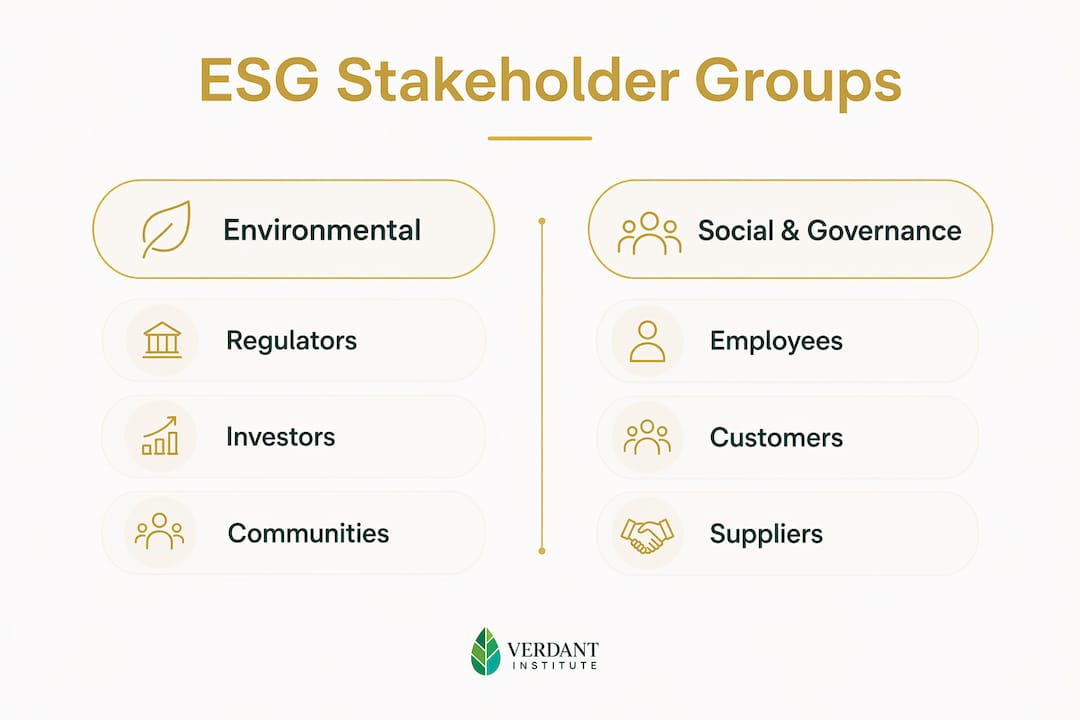
Different stakeholder groups exert pressure on different ESG domains. Research in the logistics sector illustrates this clearly: investor and customer pressures affect all three ESG pillars simultaneously, while government and international pressures concentrate primarily on environmental management. That asymmetry has direct implications for how firms should prioritize their ESG reporting and engagement efforts.
The feedback loop between ESG performance and stakeholder trust runs in both directions. Strong ESG scores attract capital from sustainability-focused investors, which in turn funds further ESG initiatives. Poor scores trigger activist pressure, regulatory scrutiny, and talent attrition. ESG disclosure functions as a mediating construct between stakeholder pressure and accounting performance, operating through legitimacy enhancement, information transparency, and efficiency gains driven by process improvement.
Key ways stakeholder groups shape specific ESG indicators:
- Investors push for governance disclosures, climate risk assessments, and supply chain transparency.
- Employees drive social metrics around pay equity, psychological safety, and career development.
- Regulators set minimum environmental thresholds and mandate disclosure standards.
- Customers increasingly reward firms with strong social and environmental records through purchasing decisions and brand loyalty.
- Communities influence social license to operate, particularly for extractive or infrastructure-heavy industries.
Firms that treat ESG metrics as a passive reporting exercise miss the point. The metrics are a structured way to listen to stakeholders and demonstrate responsiveness. That responsiveness, not the score itself, is what builds the trust that translates into long-term value.
How stakeholder theory shapes corporate sustainability strategies
Sustainability strategies built on stakeholder theory look different from those built on compliance alone. The difference shows up in how goals are set, who is consulted, and how performance is measured over time.
Practical applications follow a recognizable pattern in firms that do this well:
- Stakeholder mapping: Identify all groups with a legitimate claim on the firm's behavior, rank them by influence and urgency, and document their specific ESG-related concerns.
- Materiality assessment: Use stakeholder input to determine which ESG issues are most material to the business, a process now formalized in frameworks like the Global Reporting Initiative (GRI) and the International Sustainability Standards Board (ISSB).
- Goal-setting with stakeholder input: Set sustainability targets that reflect stakeholder priorities, not just regulatory minimums. This is where stakeholder engagement as a strategic practice separates leading firms from followers.
- Governance integration: Embed stakeholder accountability into board structures, executive compensation, and internal audit functions.
- Continuous feedback loops: Treat stakeholder relationships as dynamic rather than static, revisiting priorities as external conditions and stakeholder expectations shift.
Microsoft's approach to carbon negativity by 2030 illustrates this well. The commitment emerged from sustained engagement with employees, investors, and civil society groups who made clear that incremental carbon reduction was insufficient. The goal went beyond regulatory requirements because stakeholder pressure demanded it.
Apple's Supplier Code of Conduct is another example. Driven by customer and investor pressure over labor conditions in its supply chain, Apple built a formal supplier accountability program that now covers audits, remediation, and public reporting. The program did not originate from a compliance mandate. It originated from stakeholder demands that the company could not ignore without reputational and financial consequences.
Pro Tip: When designing a sustainability strategy, run your materiality assessment with actual stakeholder interviews, not just internal surveys. The gap between what management assumes stakeholders care about and what stakeholders actually prioritize is often where ESG strategies lose credibility.
Governance alignment is the piece most firms underinvest in. ESG corporate culture must reflect stakeholder values at every level, from the board's committee structure to how frontline managers handle supplier relationships. Firms with formalized organizational cultures that internalize stakeholder expectations consistently produce more durable ESG outcomes, particularly in compliance-intensive sectors.
Designing ESG incentives that reflect stakeholder priorities
Connecting ESG performance to executive compensation is where stakeholder theory moves from philosophy to accountability. The Business Roundtable's 2019 statement explicitly reframed corporate purpose around multiple stakeholders, and compensation design is one of the most direct levers for operationalizing that commitment.
| Incentive Component | Stakeholder Alignment Consideration | Example Metric |
|---|---|---|
| Short-term bonus | Employee and community stakeholders | Safety incident rates, employee engagement scores |
| Long-term equity | Investor and environmental stakeholders | Carbon reduction targets, ESG rating trajectory |
| Qualitative goals | Customer and regulatory stakeholders | Supply chain audit completion, regulatory compliance rate |
| Governance milestones | Board and shareholder stakeholders | Board diversity targets, audit committee independence |
Sustainable finance policies create firm value through multiple stakeholder channels: investor alignment, employee engagement, customer loyalty, and governance participation. Incentive design that ignores any of those channels leaves value on the table.
Key considerations for building stakeholder-aligned ESG incentive systems:
- Avoid greenwashing traps: ESG goals must be set with the same rigor as financial metrics. Vague qualitative targets without measurable thresholds invite "window dressing" rather than genuine performance improvement.
- Balance short and long-term horizons: Environmental targets often require multi-year investment cycles, while social metrics like employee engagement can shift within a single fiscal year.
- Differentiate by stakeholder salience: Not every stakeholder group deserves equal weight in every incentive plan. Industry context determines which groups have the most material influence on firm value.
- Disclose the design logic: Stakeholders, particularly institutional investors, increasingly scrutinize how ESG metrics are selected and weighted in compensation programs. Transparency in design builds credibility.
- Revisit annually: Stakeholder priorities evolve. An incentive plan built around 2022 ESG priorities may be misaligned with what investors and regulators expect by 2026.
The governance challenge is real. Balancing the competing priorities of employees, communities, investors, and regulators within a single incentive framework requires judgment calls that no formula can fully resolve. The firms that navigate this best tend to have compensation committees with genuine ESG expertise, not just financial acumen.
What recent research reveals about stakeholder theory and ESG effectiveness
The academic literature on stakeholder theory and ESG has matured considerably since 2020, and the findings carry direct implications for practitioners.
ESG practices are no longer voluntary responses to stakeholder demands. They are mandatory in many jurisdictions and increasingly expected as baseline behavior by institutional investors, regardless of regulatory requirements. The shift from voluntary to mandatory framing changes the strategic calculus: firms that treated ESG as optional are now facing disclosure requirements, investor exclusions, and talent market penalties.
Internal organizational capabilities matter as much as external stakeholder pressure. Firms with strong cultures and internal resources translate stakeholder demands into ESG outcomes more effectively than firms that rely on external pressure alone to drive change. This finding aligns with the resource-based view of the firm: ESG capability is a competitive asset, not just a reporting obligation.
Two failure modes appear consistently in the literature. First, stakeholder salience mismanagement: firms that prioritize the wrong stakeholder groups, or respond to vocal minorities while ignoring more material constituencies, end up with ESG strategies that satisfy no one and create genuine value for no one. Second, governance decoupling: when ESG disclosures diverge from actual operational practices, stakeholder trust erodes faster than it was built. The reputational damage from discovered greenwashing typically exceeds the short-term cost of genuine compliance.
The dynamic nature of stakeholder relationships is a point the literature emphasizes repeatedly. Effective stakeholder management requires continuous adaptation, not a static set of criteria established at the start of a reporting cycle. Stakeholder expectations shift with social movements, regulatory changes, and market conditions. Firms that treat their ESG strategy as a living document, revisited through ongoing stakeholder dialogue, consistently outperform those that treat it as an annual disclosure exercise. For a deeper grounding in the academic literature underpinning these findings, the ESG academic literature guide from Verdantinstitute provides a structured entry point.
How U.S. corporations apply stakeholder theory in ESG initiatives
American corporations have moved from theoretical endorsement of stakeholder principles to concrete operational programs, though the quality and depth of that application varies considerably by industry and firm size.
Johnson & Johnson restructured its board-level ESG oversight following sustained investor pressure over supply chain transparency and product safety. The company's materiality assessment now formally incorporates input from patient advocacy groups, healthcare providers, and community health organizations, not just shareholders and regulators. That breadth of stakeholder input directly shapes which ESG metrics J&J reports and prioritizes.
Walmart built its Project Gigaton supply chain emissions program in direct response to pressure from environmental NGOs, institutional investors, and increasingly climate-conscious consumers. The program asks suppliers to collectively avoid one billion metric tons of greenhouse gas emissions from the global value chain. The scale of ambition reflects how seriously Walmart took the convergence of stakeholder demands across investor, customer, and regulatory groups simultaneously.
BlackRock, as the world's largest asset manager, operationalized stakeholder theory from the investor side. Its annual letters to CEOs beginning in 2018 explicitly tied capital allocation to ESG performance, signaling to portfolio companies that investor stakeholders would use ESG metrics as a material factor in investment decisions. That signal reshaped how hundreds of U.S. corporations approached their ESG disclosures and strategies. Understanding ESG investment strategies helps clarify how investor-side stakeholder pressure translates into portfolio-level decisions.
Patagonia represents the most complete integration of stakeholder theory into corporate structure. The company's 2022 ownership restructuring transferred control to a trust and nonprofit dedicated to environmental causes, permanently embedding environmental stakeholder interests into the governance structure itself. It is an extreme case, but it illustrates where stakeholder-driven ESG logic leads when taken to its conclusion.
Across these examples, a common pattern holds: the most durable ESG commitments emerge when stakeholder engagement precedes strategy design rather than following it as a communication exercise.
Where ESG and stakeholder theory are heading next
The next phase of ESG development will be shaped by three converging forces: regulatory formalization, measurement standardization, and the deepening of stakeholder theory itself as a governance framework.
On the regulatory front, the Securities and Exchange Commission's climate disclosure rules and the European Union's Corporate Sustainability Reporting Directive are pushing ESG from voluntary best practice toward mandatory financial reporting. That shift elevates the importance of stakeholder theory because it forces firms to articulate which stakeholders they are accountable to and how they measure that accountability, not just whether they have an ESG policy.
Measurement standardization is accelerating through bodies like the ISSB, which released its first two sustainability disclosure standards in 2023. As reporting frameworks converge, the question shifts from "what do we disclose?" to "how do we actually perform?" Stakeholder theory provides the answer: performance is defined by whether the firm is genuinely creating value for the full range of groups that depend on it.
The theory itself continues to evolve. Current research is pushing toward more dynamic models of stakeholder relationships that account for power asymmetries, coalition formation among stakeholder groups, and the role of digital platforms in amplifying stakeholder voices. Social media has fundamentally changed the speed at which stakeholder sentiment can shift and the scale at which reputational damage can accumulate. Firms that built their ESG strategies around annual reporting cycles are discovering that stakeholder expectations now move faster than their governance structures can accommodate.
Artificial intelligence is emerging as both a tool and a challenge in this context. AI-driven ESG analytics can process stakeholder sentiment at scale, identifying emerging concerns before they become crises. But AI systems trained on historical data can also systematically underweight the concerns of stakeholder groups that were historically marginalized, reproducing the same blind spots that stakeholder theory was developed to correct. Getting the governance of AI-assisted ESG analysis right will be one of the defining challenges of the next decade.
Key Takeaways
Stakeholder theory is not a supplement to ESG strategy; it is the framework that gives ESG its strategic coherence, accountability structure, and capacity to generate durable corporate value.
| Point | Details |
|---|---|
| Stakeholder theory underpins ESG | ESG metrics map directly onto stakeholder claims across environmental, social, and governance dimensions. |
| Reciprocity drives financial returns | Stakeholders treated well reciprocate through loyalty, engagement, and cooperation, producing measurable performance gains. |
| Governance decoupling destroys value | When ESG disclosures diverge from actual practices, stakeholder trust erodes faster than it was built. |
| Internal capabilities matter | Firms with strong organizational cultures translate stakeholder demands into ESG outcomes more effectively than those relying on external pressure alone. |
| Stakeholder engagement must be dynamic | Effective ESG management requires continuous adaptation as stakeholder expectations shift with regulatory, social, and market conditions. |