

Impact investing exit strategies are the mechanisms by which impact investors realize financial returns while preserving the social or environmental mission of their portfolio companies. Understanding these exits is not optional for serious practitioners. Exit counts dropped more than 60% since the 2021 peak, making disciplined exit planning more consequential than ever. With M&A dominating liquidity events and new vehicles like Continuation Vehicles reshaping the field, finance professionals need a clear map of every available path. This guide covers the full spectrum of impact investing exit strategies explained through a 2026 lens, from the mechanics of each route to the practical steps that protect both returns and mission.
What are the main exit strategies used in impact investing?
M&A represents 85% of all liquidity events in impact investing, with IPOs accounting for only 5% in 2024 and 0% in 2023. That concentration matters because it shapes how fund managers should spend their time and relationships. Relying on a public market exit is a low-probability bet for most impact funds.
The four primary exit routes are:
- Mergers and acquisitions (M&A): The dominant path. A strategic acquirer or financial buyer purchases the portfolio company. The risk is mission drift if the acquirer does not share the company's values.
- Initial public offerings (IPOs): Rare but high-impact. IPOs unlock large liquidity events and public accountability, though lockup periods delay actual distributions.
- Secondary sales: A fund manager sells its stake to another investor, often a secondary fund, while the company stays private. This preserves mission alignment and recycles capital.
- Continuation Vehicles (CVs): The fund transfers select assets into a new vehicle, giving existing LPs the choice to cash out or roll over. 20% of private equity deals at term are expected to pass through CVs in 2026.
Pro Tip: Map your exit route by asset type, not by fund timeline. Infrastructure assets suit secondary sales or CVs; high-growth ventures suit M&A or IPO paths.
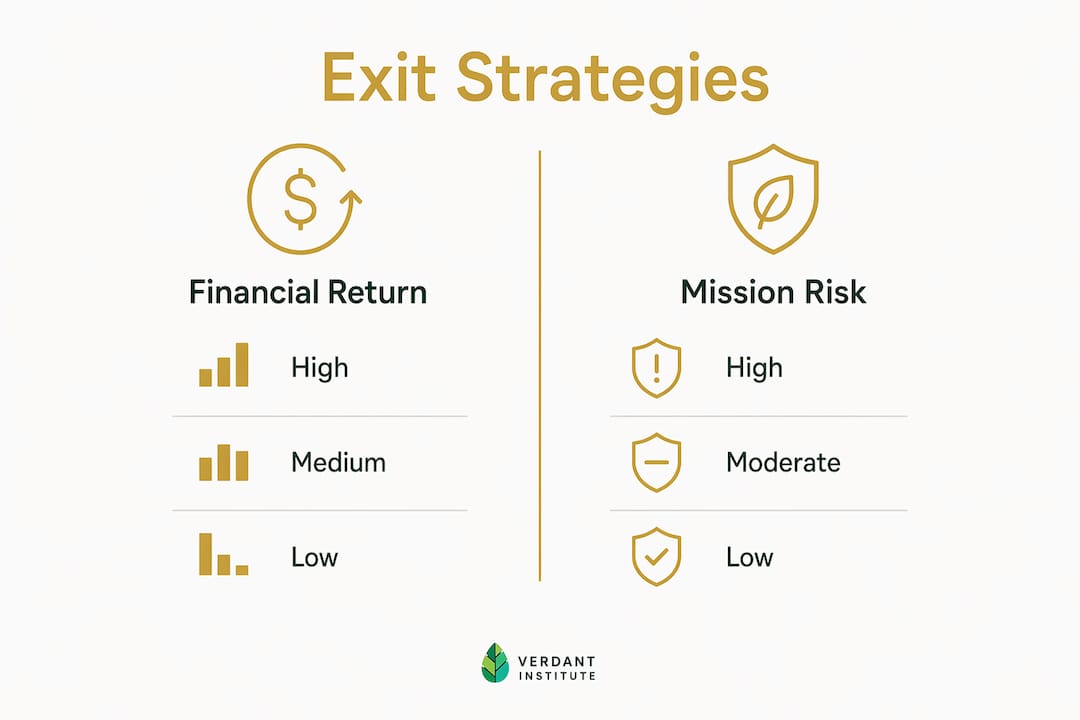
The financial trade-offs between these routes are real. Median returns for angel-backed exits hover at 1.3x, and 1 in 4 exits returns less than invested capital. That figure underscores why exit selection is as important as entry selection. Choosing the wrong route at the wrong time destroys value on both the financial and impact dimensions.

| Exit route | Financial return potential | Mission preservation risk |
|---|---|---|
| M&A | High, acquirer-dependent | Moderate to high |
| IPO | Very high, subject to lockup | Low if governance is embedded |
| Secondary sale | Moderate | Low, buyer is typically mission-aligned |
| Continuation Vehicle | Variable | Low to moderate |
How do impact investing exits balance returns with mission?
The central tension in impact investment divestment is that financial exits often arrive before impact has fully matured. Traditional forced exits after 5–7 years frequently conflict with the longer timelines required for social or environmental outcomes to take hold. A clean financial exit can undo years of carefully built impact if the incoming owner does not maintain the mission.
Finance professionals use several tools to reduce this risk:
- Impact covenants: Contractual obligations embedded in sale agreements that require the acquirer to maintain specific impact metrics for a defined period.
- Governance controls: Board seat retention or observer rights post-exit to monitor mission adherence.
- Permanent capital vehicles: Structures with no fixed end date, allowing impact to compound without forced liquidation pressure.
- Impact by design: Selecting business models where the social or environmental outcome is inseparable from revenue generation, making mission drift commercially irrational for any owner.
"Forced early exits conflict with impact maturation. Permanent capital vehicles align investment with long-term impact goals far better than conventional fund structures with fixed terms."
The LP side of this equation is shifting fast. Impact funds increasingly face LP scrutiny on realized value and distributions earlier than before, with credible liquidity paths demanded by Fund II. That pressure creates a genuine conflict: LPs want distributions sooner, but impact often needs more time. The funds that resolve this tension well are those that build impact metrics directly into their exit narratives, showing acquirers and secondary buyers why the mission is a financial asset, not a constraint.
Pro Tip: Integrate impact KPIs into your data room from day one. Buyers who see impact metrics alongside financial metrics are more likely to preserve them post-close.
Understanding the fundamentals of impact investing is the prerequisite for designing exits that hold up under LP scrutiny. Without that foundation, exit planning becomes reactive rather than deliberate.
What emerging trends are shaping exit strategies in 2026?
The exit environment for impact funds is changing faster in 2026 than at any point since 2021. Three forces are driving that change: impact-oriented IPOs, the rise of secondary markets as infrastructure, and the proliferation of Continuation Vehicles.
Impact-oriented IPOs are unlocking significant capital. Anthropic stakes have grown more than 30x since initial investment, and LPs with exposure to SpaceX through DBL Partners received large liquidity spikes that freed capital for reinvestment in impact. These events are rare, but they demonstrate that mission-aligned companies can generate top-decile financial returns at exit.
Secondary markets have moved from a niche workaround to essential infrastructure. Secondary markets provide mission-aligned liquidity that allows companies to remain private and sustain impact while enabling fund recycling. This matters because it decouples liquidity from ownership change, removing the mission-drift risk that comes with a full acquisition.
New mechanisms are also entering the market:
- Liquidity Guarantee Facilities: Structures where a third party guarantees a minimum return to LPs, allowing the fund to hold assets longer without LP pressure to exit.
- Impact-linked secondary pricing: Secondary buyers applying a premium or discount based on verified impact performance, creating a financial incentive for mission preservation.
- Blended finance structures: Combining concessional capital with commercial capital to extend holding periods and reduce exit pressure on early-stage impact assets.
| Mechanism | Primary benefit | Key risk |
|---|---|---|
| Impact-oriented IPO | Maximum liquidity, public accountability | Lockup periods, market volatility |
| Secondary sale | Mission preservation, capital recycling | Lower valuation than strategic M&A |
| Continuation Vehicle | Extended hold, LP optionality | Perception of hiding underperformers |
| Liquidity Guarantee Facility | LP confidence, longer hold | Cost of guarantee reduces net return |
Continuation Vehicles carry real reputational risk. CVs can create negative perceptions of hiding underperforming assets and delaying inevitable write-downs, creating what practitioners call "zombie funds." Used well, they are a genuine tool for extending impact. Used poorly, they are a way to avoid difficult conversations with LPs.
How can finance professionals plan and execute impact investing exits?
Effective exit planning starts years before the transaction closes. Exit strategies must be designed with founders 2+ years ahead of the transaction to map acquirers and position the company for growth investors. Waiting until year seven of a ten-year fund to think about exit options is a structural mistake.
A practical exit planning process follows these steps:
- Define exit criteria at investment entry. Set financial thresholds (target multiple, minimum DPI) and impact thresholds (minimum impact metric performance) that must be met before any exit proceeds.
- Map acquirers and secondary buyers by year three. Identify strategic acquirers who share the mission, secondary funds active in the sector, and growth-stage investors who could take the company to the next stage.
- Build the impact narrative into the business case. Winning impact funds link impact metrics directly to business value, making the social or environmental outcome a driver of valuation, not a footnote.
- Manage LP expectations on DPI and timing. Distributions to Paid-In capital is the metric LPs watch most closely. Communicate realistic timelines early and update them as market conditions change.
- Avoid premature exits driven by fund term pressure. A forced exit at year eight that returns 1.2x is worse for fund reputation than a well-structured CV that returns 2.5x at year eleven.
Pro Tip: Run an annual "exit readiness review" for each portfolio company starting at year three. Score each company on acquirer interest, impact metric strength, and management team stability. This prevents year-nine surprises.
Exploring the full range of impact investing asset classes helps fund managers match exit routes to asset type from the start. Infrastructure assets, for example, suit secondary sales or permanent capital structures far better than venture-style M&A exits.
Key Takeaways
Successful impact investing exits require early planning, mission-aligned buyer selection, and impact metrics embedded in the exit narrative from day one.
| Point | Details |
|---|---|
| M&A dominates exits | M&A accounts for 85% of liquidity events; plan relationships with strategic acquirers early. |
| Secondary markets preserve mission | Secondary sales allow companies to stay private and sustain impact while recycling fund capital. |
| CVs carry reputational risk | Continuation Vehicles can signal hidden underperformance; use them only for genuinely strong assets. |
| LP scrutiny is rising | Credible DPI and liquidity paths are now expected by Fund II, not Fund IV. |
| Plan exits 2+ years early | Mapping acquirers and positioning companies for growth investors requires a multi-year runway. |
What I've learned about exits that most fund managers won't say out loud
The honest reality of impact investing exits in 2026 is that the field is still catching up to its own ambitions. LP conversations have become sharper and more demanding. Investors who accepted vague impact narratives in 2019 now want verified metrics, credible DPI timelines, and a clear answer to the question: "Who buys this, and at what multiple?"
What I find most underappreciated is the role of secondary markets. The finance community still treats secondary sales as a fallback when the "real" exit fails. That framing is wrong. A well-structured secondary sale to a mission-aligned buyer is often the best outcome for both the company and the fund. It preserves impact, recycles capital, and avoids the mission-drift risk that comes with a strategic acquisition by a buyer who views the social outcome as a cost center.
Continuation Vehicles are the most misused tool in the current market. I have seen them used brilliantly to extend the hold on genuinely high-performing assets that needed more time. I have also seen them used to avoid writing down assets that should have been marked down two years earlier. The difference is transparency. Funds that communicate clearly about why they are using a CV, which assets are in it, and what the exit plan looks like within the vehicle earn LP trust. Funds that use CVs as a delay mechanism destroy it.
The deeper issue is that exit planning is still treated as a late-stage activity in too many impact funds. The funds that consistently deliver strong financial and impact outcomes start exit conversations at the investment committee stage, not at year seven. That shift in mindset is the single biggest lever available to fund managers right now.
— Charles
Verdantinstitute: build the skills to execute better exits
Finance professionals who want to move from understanding exit theory to executing it with confidence need more than market data. They need structured frameworks for impact measurement, LP communication, and exit analysis.
Verdantinstitute offers structured learning tracks built specifically for impact investing practitioners. The platform covers impact measurement, ESG analysis, transition finance, and advanced practice areas that directly apply to exit planning and LP reporting. With CPD tracking, certifications, and courses designed for working professionals, it fits into a demanding schedule without sacrificing depth. Plans start at $58/month for professionals. Review the full course and pricing options to find the track that matches your current role and exit planning responsibilities.
FAQ
What is the most common exit strategy in impact investing?
M&A is the dominant exit route, representing 85% of all liquidity events in impact investing as of 2024. IPOs account for only 5% of exits and were entirely absent in 2023.
How do impact investors preserve mission at exit?
Impact investors use impact covenants, governance controls, and mission-aligned buyer selection to protect social and environmental outcomes after a sale or transfer of ownership.
What is a Continuation Vehicle in impact investing?
A Continuation Vehicle transfers select fund assets into a new structure at the end of a fund's term, giving LPs the option to cash out or roll over their investment. About 20% of private equity deals at term are expected to use CVs in 2026.
When should impact fund managers start planning exits?
Exit planning should begin at least two years before the intended transaction, with acquirer mapping and impact narrative development starting as early as year three of the fund.
How do secondary markets support impact investing exits?
Secondary markets allow fund managers to sell stakes to mission-aligned buyers while portfolio companies remain private, preserving impact and recycling capital without triggering ownership changes that risk mission drift.