

Place-based impact investing is defined as the deliberate deployment of capital within specific geographic communities to generate measurable financial returns alongside positive social and environmental outcomes. This approach differs from broad ESG mandates or thematic funds because it targets the economic and social conditions of a named place, not just a sector or asset class. The industry term "community-focused investment" often appears alongside it, but place-based investing carries a more precise meaning: capital is structured around local needs, local intermediaries, and local absorptive capacity. Institutional portfolios are now advised to allocate around 5% to place-led intermediaries to expand system capacity in a material way. Individual investors can enter democratized funds with as little as $1,000, making this one of the few impact investing strategies that spans retail and institutional participation.
What is the role of place-based impact investing in modern portfolios?
Place-based impact investing fills a structural gap that broad ESG funds cannot. National or global funds allocate capital by sector or rating, but they rarely direct resources to the specific neighborhoods, small businesses, or community infrastructure that drive local economic resilience. Place-based investments correct that gap by anchoring capital to geography and governance.
The 2026 Institutional Impact Investing Handbook confirms that impact is now central to mainstream portfolio construction, not a boutique satellite activity. Climate adaptation, social cohesion, and demographic change are now recognized as material drivers of valuation and cash flow. That shift means place-based strategies are no longer optional for institutions managing long-duration liabilities.

For finance professionals, the practical implication is clear. A pension fund or foundation that ignores local economic conditions in its investment geography faces unpriced systemic risk. Place-based investing converts that risk into a managed, return-generating allocation. Understanding the full range of impact investing strategies available is the first step toward building that allocation correctly.
How do community intermediaries like CDFIs enable place-based investing?
Community Development Financial Institutions, known as CDFIs, are the operational backbone of most place-based investment strategies. They do far more than lend money. CDFIs act as market-builders, diagnosing local constraints such as staffing shortfalls, regulatory barriers, and credit gaps, then designing financing solutions that fit those specific conditions.
Their functions include:
- Market diagnosis: Identifying which enterprises and projects have genuine absorptive capacity for outside capital
- Risk translation: Converting community-level risk into terms that institutional investors can underwrite
- Technical assistance: Supporting borrowers through financial management, compliance, and growth planning
- Advocacy: Shaping local policy environments to sustain investment conditions over time
Community stewardship trusts extend this model further. The SWATS Community Stewardship Trust and the Kensington Corridor Trust both allow neighborhood residents to invest from as little as $10 per month. That entry point is not symbolic. It builds local ownership, aligns investor and community incentives, and creates a feedback loop that external capital alone cannot replicate.
Pro Tip: When evaluating a CDFI as an investment intermediary, ask specifically about its technical assistance program. CDFIs with active borrower support consistently show lower default rates and stronger community outcomes than those focused purely on loan origination.
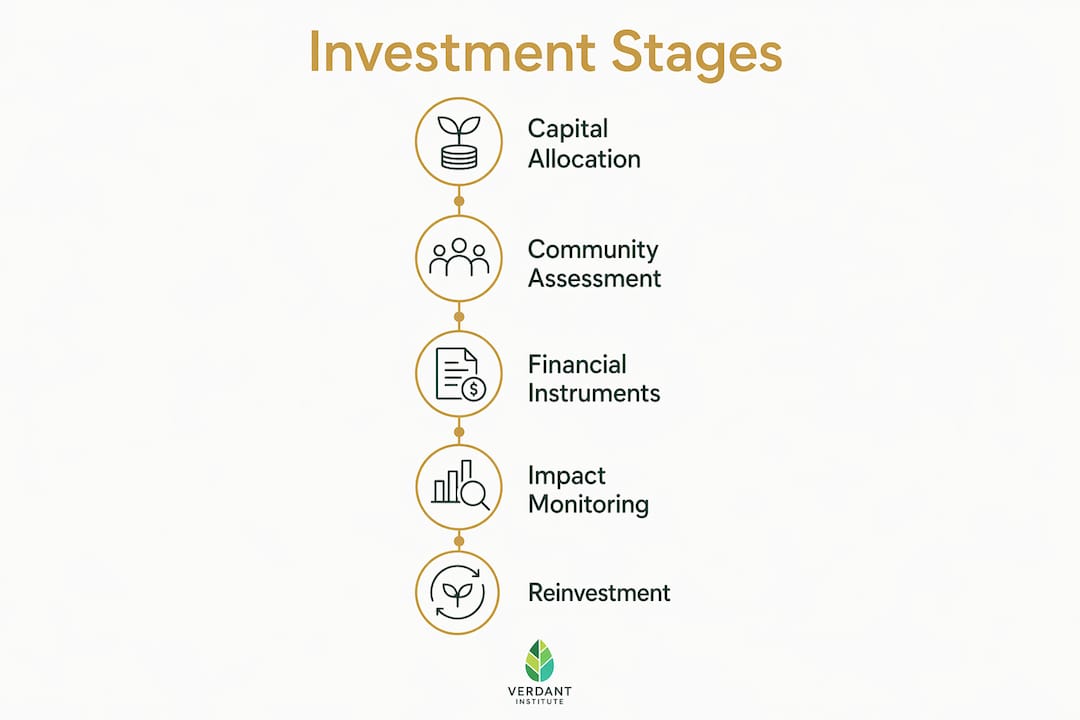
What financial instruments and structures are used in place-based investing?
Place-based investing uses a range of instruments, and understanding each one helps investors match their capital to the right opportunity.
| Instrument | Typical investor | Key feature |
|---|---|---|
| Community investment notes | Accredited and retail | Fixed return, mission-aligned, high renewal rate |
| Blended capital funds | Institutional | Combines grants, debt, and equity in one vehicle |
| Community stewardship trust shares | Local residents | Entry from $10/month, ownership stake in local assets |
| Direct CDFI loans | Institutional | Targeted to specific local enterprises or projects |
Community investment notes stand out for their investor loyalty. About 85% of noteholders renew their investments upon maturity. That renewal rate signals genuine satisfaction with both financial performance and mission alignment, not just inertia.
Blended capital models are the most powerful structure for complex community projects. They layer philanthropic grants at the first-loss position, debt in the mezzanine, and equity at the senior level. This structure lets a single fund serve a diverse set of community enterprises that no single capital type could support alone. The Boston Impact Initiative Fund II raised $22 million across investment tiers ranging from $1,000 to $1 million, demonstrating that blended structures can attract both retail and institutional capital simultaneously.
Pro Tip: Before committing to a community investment note, confirm whether the issuer reports impact metrics alongside financial returns. Notes backed by transparent impact data tend to attract repeat investors and carry lower reputational risk for institutional allocators.
For a broader view of how these instruments fit within a portfolio, the impact investing asset classes guide from Verdantinstitute provides a structured breakdown.
Why are institutional investors integrating place-based strategies into their core portfolios?
The shift is not ideological. It is financial. Institutional investors managing long-duration assets, such as pension funds, endowments, and insurance reserves, face systemic risks that traditional asset allocation models do not capture. Climate-driven displacement, workforce shortages in underinvested regions, and social instability all affect cash flows and valuations in ways that sector-based analysis misses.
The 2026 institutional consensus identifies three primary drivers pushing place-based strategies from the periphery to the core:
- Climate adaptation risk: Physical climate risk concentrates in specific geographies. Investors with local exposure need local capital solutions to manage it.
- Social cohesion as a valuation factor: Communities with stronger social infrastructure show more stable economic activity, which supports the performance of impact investing across asset classes.
- Demographic change: Aging populations and migration patterns reshape local labor markets and consumer demand, creating both risk and opportunity for place-aware investors.
"Impact is no longer a niche. It is integral to mainstream portfolio construction, recognizing systemic risks as core financial factors. Institutions that treat place-based investing as a satellite activity will find themselves underexposed to the community-level dynamics that increasingly drive long-term returns." — Institutional Impact Investing Handbook 2026
A 5% allocation to place-led intermediaries does not require abandoning return targets. It requires rethinking where returns come from and accepting that community economic health is a financial variable, not just a social one.
What are the key challenges in effective place-based impact investing?
The most common mistake investors make is treating place-based investing as a capital deployment problem. The real constraint is absorptive capacity. Local financial infrastructure determines how much capital a community can productively use, and most investors underestimate how long it takes to build that infrastructure.
The critical challenges include:
- Absorptive capacity limits: Communities may lack the governance structures, financial management capacity, or project pipelines to deploy large capital injections quickly or effectively.
- Context specificity: Replicating successful models from one geography to another rarely works. Local governance, culture, and economic history shape what structures will hold.
- Institutional misalignment: Traditional advisor incentive structures favor liquid, standardized assets. Place-based investing requires long time horizons and deep local knowledge that most external advisors are not built to provide.
- Collaboration gaps: No single institution can build the local ecosystem alone. Collaborative due diligence and pooled capital deployment are operational necessities, not optional enhancements.
Investors who treat these challenges as execution details rather than structural design questions consistently underperform. The solution is not more capital. It is better-designed capital, deployed through intermediaries with genuine local knowledge and accountability.
How can investors practically engage with place-based impact investing?
Entry into place-based investing follows a clear progression, whether you are an individual investor or an institutional allocator.
- Start with a community investment note. These instruments offer fixed returns, transparent impact reporting, and low minimums. They are the most accessible on-ramp for investors new to the asset class.
- Identify a CDFI aligned with your geography. CDFIs vary significantly by focus area, from affordable housing to small business lending to rural infrastructure. Match the CDFI's mandate to your portfolio's geographic exposure.
- Join a collaborative capital pool. Multi-investor vehicles like the Boston Impact Initiative Fund II allow smaller institutions to participate in deals that require scale. They also distribute due diligence costs across partners.
- Build toward a blended capital allocation. Once you understand local conditions, blended structures let you deploy grants, debt, and equity in a coordinated way that maximizes community impact and manages risk across the capital stack.
Pro Tip: If you are an institutional investor making your first place-based allocation, partner with a CDFI that has at least five years of operating history in your target geography. Track record in a specific place is a stronger predictor of success than national brand recognition.
The distinction between place-based investing and philanthropy matters here. Investors who understand how impact investing differs from philanthropy make better decisions about capital structure and return expectations from the start.
Key Takeaways
Place-based impact investing succeeds when capital is matched to local absorptive capacity through trusted intermediaries, not when volume alone drives deployment.
| Point | Details |
|---|---|
| Define the geography first | Effective place-based strategies start with local conditions, not capital availability. |
| CDFIs are essential partners | They diagnose constraints, manage risk, and translate capital into community outcomes. |
| Blended capital outperforms single-type funding | Layering grants, debt, and equity serves more community enterprises and manages risk better. |
| 5% institutional allocation builds system capacity | A targeted allocation to place-led intermediaries materially expands local financial infrastructure. |
| Collaboration is not optional | Joint due diligence and pooled capital deployment accelerate impact and reduce per-investor cost. |
Why I think most institutions are still getting place-based investing wrong
The framing I see most often is wrong. Institutions treat place-based investing as a values exercise, something you do to demonstrate mission alignment or satisfy a stakeholder audience. That framing guarantees underperformance.
The institutions that generate real returns from place-based strategies treat it as a market intelligence problem. They invest in understanding local conditions before they deploy capital. They build relationships with CDFIs years before they need them. They accept that the first allocation is partly an infrastructure investment, not just a return-seeking one.
The other pattern I find telling is the over-reliance on external advisors. Foundations that outsource their place-based strategy to generalist advisors consistently struggle. Those advisors are not incentivized to do the slow, context-heavy work that place-based investing requires. Internal capacity building is not a cost. It is the investment that makes every subsequent allocation more effective.
The future of this field is genuinely promising. Democratic entry points, collaborative capital pools, and the mainstreaming of impact as a portfolio factor all point toward a larger, more sophisticated market. But the institutions that will lead it are the ones building local knowledge and internal conviction now, not the ones waiting for the market to mature before they engage.
— Charles
Build the skills to deploy place-based capital effectively
Finance professionals who want to move from understanding place-based investing to executing it need more than market awareness. They need structured knowledge of ESG frameworks, impact measurement, and sustainable finance structures.
Verdantinstitute offers a subscription-based learning platform built specifically for finance professionals at this stage. With 16 courses and over 160 lessons covering impact investing, transition finance, and ESG analysis, the platform provides CPD-tracked, certification-backed training that translates directly into portfolio practice. Professional plans start at $58 per month. Students access the full curriculum at $18 per month. Review the full course and pricing options to find the track that fits your current role and goals.
FAQ
What is place-based impact investing?
Place-based impact investing is the deployment of capital within a specific geographic community to generate financial returns alongside measurable social and environmental outcomes. It differs from broad ESG investing by anchoring capital to local conditions, intermediaries, and governance structures.
How do CDFIs support place-based investment strategies?
CDFIs act as market-builders and risk translators, diagnosing local constraints and providing financing solutions tailored to specific community needs. They go beyond lending to offer technical assistance, advocacy, and borrower support that sustains investment outcomes over time.
What returns can investors expect from community investment notes?
Community investment notes offer fixed returns with strong investor loyalty, with about 85% of noteholders renewing upon maturity. Returns vary by issuer and structure, but the renewal rate reflects consistent satisfaction with both financial and impact performance.
Why is local absorptive capacity more important than capital volume?
Communities can only productively deploy capital at the rate their governance, financial management, and project pipelines allow. Investors who ignore absorptive capacity and push large capital volumes into underprepared markets consistently see slower deployment and weaker outcomes.
How much should an institutional portfolio allocate to place-based strategies?
Institutional portfolios are advised to allocate around 5% to place-led intermediaries and institutions. That level of allocation materially expands local financial infrastructure without concentrating portfolio risk in illiquid community assets.