

For U.S. finance professionals and students searching for verdalytics.com alternatives in ESG and sustainable finance training, Verdant Institute is the recommended subscription option. At $18/month for students and $58/month for professionals, it covers 16 courses and over 160 lessons with CPD tracking and structured learning tracks from foundations to advanced practice. If you need a formal external credential or a university-backed certificate, the strongest alternatives are:
- CFA Institute — Certificate in ESG Investing: Best for employer-recognized credentialing; exam-based, higher cost, 130+ study hours
- GARP — Sustainability and Climate Risk (SCR): Best for risk-focused finance roles; exam-based credential, recognized by institutional employers
- PRI Academy: Best for responsible investment fundamentals; per-course model, self-paced
- ISS ESG Academy: Best for institutional and corporate ESG practitioners; modular, per-course pricing
- Coursera/edX university specializations: Best for academic rigor and credit-bearing certificates; subscription or per-course, 3–6 months typical
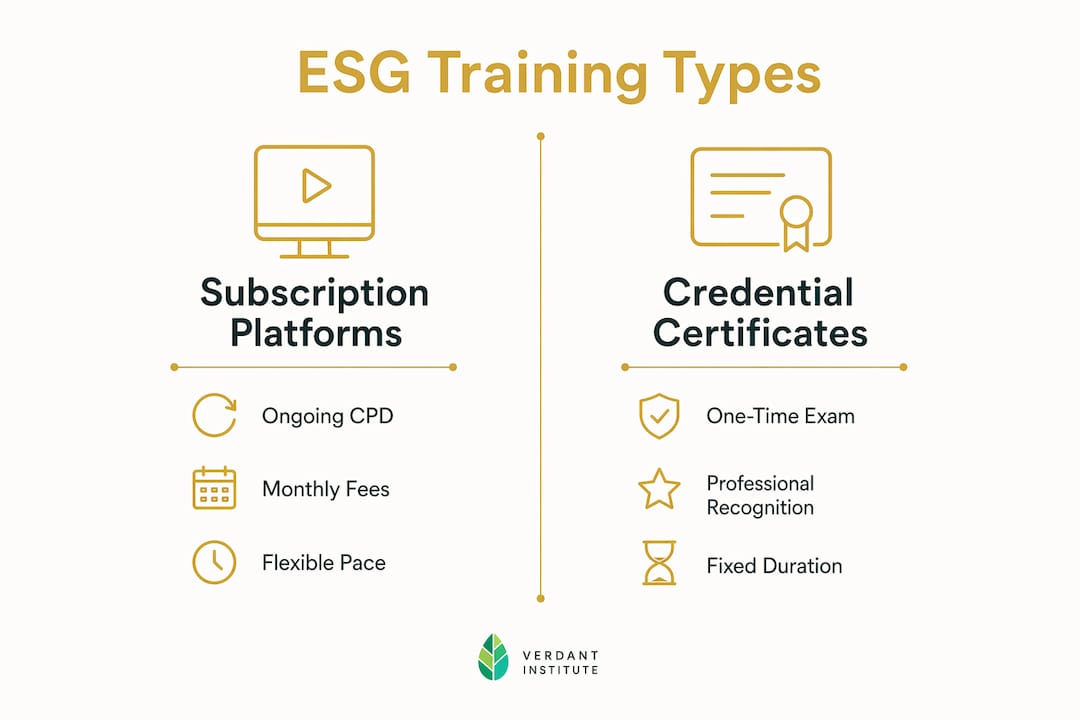
Subscription platforms are offered with monthly fees. Per-course certificates are priced per individual course. Industry credentials such as CFA ESG and GARP SCR carry higher exam fees. Time to complete can vary widely, from shorter introductory courses to longer industry credential programs.
Table of Contents
- Which Verdalytics.com alternatives compare best for ESG training?
- How do you choose the right ESG training for your career?
- What does each ESG training provider actually deliver?
- Key Takeaways
- Why subscription learning is underrated for ESG professionals
- Verdant Institute: subscription ESG training built for finance professionals
- Useful sources and further reading
Which Verdalytics.com alternatives compare best for ESG training?
| Provider | Ideal audience | Pricing model | Format | Curriculum depth | Certification/CPD | Time to complete | Institutional licensing |
|---|---|---|---|---|---|---|---|
| Verdant Institute | Finance pros and students | Subscription ($18–$58/mo) | Self-paced | Foundations → Advanced | CPD tracking + completion cert | 4–12 weeks per track | Yes |
| CFA ESG Investing | Investment professionals | Per exam ($700–$1,000+) | Self-study + exam | Intermediate → Advanced | Externally recognized credential | 130+ hours | No |
| GARP SCR | Risk and portfolio managers | Per exam (~$500–$900) | Self-study + exam | Intermediate → Advanced | Externally recognized credential | 100–150 hours | No |
| PRI Academy | ESG analysts, asset managers | Per course ($200–$500) | Self-paced | Foundations → Intermediate | Completion certificate | 4 weeks | Limited |
| ISS ESG Academy | Corporate and institutional ESG | Per course/module | Self-paced | Foundations → Advanced | Completion certificate | Varies by module | Yes |
| Coursera/edX | Students, career changers | Subscription or per course | Self-paced/cohort | Foundations → Intermediate | University certificate | 3–6 months | Yes |
One-line verdicts:
- Verdant Institute: The most cost-efficient path for continuous CPD and broad ESG coverage without committing to a single credential exam.
- CFA ESG: Choose this when a hiring manager or promotion committee explicitly asks for an externally recognized ESG credential.
- GARP SCR: The right pick for roles centered on climate risk, scenario analysis, or regulatory stress testing.
- PRI Academy: Solid for responsible investment fundamentals, particularly if your firm is a PRI signatory.
- ISS ESG Academy: Fits corporate sustainability teams and institutional investors who need modular, topic-specific training.
- Coursera/edX: Worth it when academic rigor, university branding, or credit-bearing potential matters to your employer.
Pricing shape: Subscription platforms offer access via monthly payments with ongoing commitment. Per-course certificates provide defined deliverables for individual fees. Industry credentials have higher upfront costs but provide strong external recognition. Subscription-based learning is the most cost-efficient option for continuous CPD and broad topic coverage.
How do you choose the right ESG training for your career?
Start with your career objective. A credential signals competence to a hiring committee; a subscription builds skills over time. Those are different jobs, and conflating them leads to wasted money.
Core decision criteria:
- Career objective: Are you targeting a specific role that lists CFA ESG or GARP SCR as preferred? Or do you need ongoing CPD to satisfy an employer's annual training requirement?
- Employer recognition: Ask HR or a recruiter whether they recognize the certificate before enrolling. Some firms accept any CPD-tracked completion; others require named credentials.
- CPD tracking: If your employer or professional body requires documented CPD hours, confirm the platform logs and exports them.
- Format preference: Self-paced works for busy professionals; cohort formats add accountability but reduce flexibility.
- Budget: Monthly subscription vs. one-time exam fee vs. per-course payment — each has a different cash-flow profile.
- Team licensing: If you are buying for a team, ask whether the provider offers bulk or institutional pricing.
Questions to ask before enrolling:
- Is the certificate externally recognized by a professional body or employer?
- Are sample lessons or a free preview available before payment?
- Does the platform track and export CPD hours?
- Who are the instructors, and what are their credentials?
- Is there a published syllabus with learning outcomes?
Pro Tip: Before enrolling anywhere, send the certificate name to your HR team or a recruiter in your target role and ask directly: "Would this satisfy your CPD requirement or credential preference?" One email saves you hundreds of dollars and months of study.
Red flags to avoid:
- No published syllabus or sample lessons
- Instructor credentials not listed
- No completion certificate or CPD tracking
- Opaque or hidden pricing
- Domain landing pages with no active course catalog (some vendor names resolve to parked domains rather than live courses — always verify an active syllabus page before assuming a provider is operational)
| Path | Typical time to complete | Typical cost (U.S.) |
|---|---|---|
| Subscription platform (e.g., Verdant Institute) | courses may take several weeks per track | monthly subscription pricing applies |
| Per-course certificate (PRI Academy, ISS ESG) | course durations vary | fees charged per course |
| Industry credential (CFA ESG, GARP SCR) | typically requires several months of study | involves exam fees |
| University specialization (Coursera/edX) | multi-month course sequences | pricing varies between subscription and per course. |
What does each ESG training provider actually deliver?
Verdant Institute
Verdant Institute is built specifically for finance professionals and students who need structured, CPD-tracked ESG training without the commitment of a credential exam. The platform's 16 courses and 160+ lessons span Academic Foundations, Foundations, Deep Dives into specific ESG topics, and Advanced Practice areas including transition finance and net-zero strategies. Students pay $18/month; professionals pay $58/month. Institutional licensing is available for universities and finance teams. Free previews of course content are accessible before subscribing. For professionals who need to cover ESG research skills, disclosure analysis, and data interpretation across a full year of CPD, this is the most cost-efficient path.
CFA Institute — Certificate in ESG Investing
Designed for investment professionals who need a globally recognized credential. The curriculum covers ESG integration across asset classes, stewardship, and sustainable investment strategies at an intermediate-to-advanced level. The exam-based format requires roughly 130+ study hours. Exam and registration fees typically run $700–$1,000+ depending on membership status. No institutional licensing model; each candidate registers individually. The CFA ESG certificate carries strong employer recognition, particularly at asset managers and pension funds.

GARP — Sustainability and Climate Risk (SCR) Certificate
GARP's SCR is the credential of choice for risk managers, portfolio managers, and analysts whose roles center on climate scenario analysis, physical and transition risk, and regulatory frameworks like TCFD. The exam-based format requires 100–150 study hours. Fees typically fall in the $500–$900 range. Employer recognition is strongest at banks, insurers, and institutional investors with formal risk functions. No self-paced subscription option; candidates purchase study materials and sit a proctored exam.
PRI Academy
The PRI Academy offers self-paced courses on responsible investment fundamentals, ESG integration, and stewardship. Courses are sold individually, typically $200–$500 each, and award completion certificates. The curriculum is particularly strong for professionals at PRI signatory firms, where the PRI framework is already embedded in investment processes. Institutional licensing is limited. No formal exam; completion is assessed through module quizzes and assignments.
ISS ESG Academy
ISS ESG Academy targets corporate sustainability teams and institutional investors who need modular, topic-specific training rather than a broad curriculum. Courses cover ESG ratings methodologies, proxy voting, climate data, and regulatory reporting. Pricing is per course or per module and is not always publicly listed. Institutional licensing is available. The modular structure suits teams that need targeted upskilling on a specific topic rather than a full learning track.
Coursera and edX university specializations
University-backed specializations on Coursera and edX offer academic rigor and, in some cases, credit-bearing certificates from institutions like Columbia, Yale, or the University of Edinburgh. Finance professionals use these when employer recognition of a university brand matters or when they want a structured multi-course sequence. Pricing is either per course ($49–$299) or through a platform subscription. Most specializations run 3–6 months at a self-paced rate of 4–6 hours per week. Institutional licensing is available through Coursera for Business and edX for Business. For students, these are often the most accessible entry point to ESG investment strategies before moving to a professional credential.
Key Takeaways
For finance professionals and students, the right ESG training choice depends on whether you need ongoing CPD, a formal credential, or academic rigor — and Verdant Institute is the strongest subscription option for continuous, CPD-tracked learning.
| Point | Details |
|---|---|
| Subscription vs. credential | Subscription models suit ongoing CPD; credentials like CFA ESG and GARP SCR involve higher costs and signal formal competence. |
| Verify employer recognition first | Ask HR or a recruiter whether a certificate satisfies their requirement before enrolling anywhere. |
| Industry credentials for specific roles | Choose CFA ESG or GARP SCR when a job description or promotion criteria explicitly names them. |
| University certificates for academic rigor | Coursera/edX specializations work best when a university brand or credit-bearing potential matters to your employer. |
| Verdant Institute for CPD and breadth | With 16 courses, CPD tracking, and plans from $18/month, Verdant Institute is the most cost-efficient path for continuous ESG upskilling. |
Why subscription learning is underrated for ESG professionals
The ESG credential market has a visibility problem. CFA and GARP certificates get the most attention in job postings, so professionals assume they are always the right answer. They are not.
A credential is a one-time signal. It tells an employer you passed an exam at a point in time. What it does not do is keep you current as SFDR, ISSB, and SEC climate disclosure rules shift every 12–18 months. A subscription platform does that job. The professionals I see struggle most in ESG roles are not the ones without a credential — they are the ones who stopped learning after they got one.
Verdant Institute's model is built for exactly this: structured tracks you can move through at your own pace, CPD hours you can document, and content that covers the topics finance employers actually care about, from ESG data divergence to fixed income integration. For a student, $18/month is a fraction of what a single credential exam costs. For a professional, $58/month is less than one hour of continuing education at most conferences.
That said, if your target employer lists CFA ESG or GARP SCR as a preferred credential, get the credential. The two are not mutually exclusive — many professionals use a subscription platform to build skills continuously and sit a credential exam when the career moment calls for it.
Verdant Institute: subscription ESG training built for finance professionals
Finance professionals who want CPD-tracked, employer-relevant ESG training without a multi-month credential commitment have a direct path at Verdant Institute. The platform gives you access to 16 structured courses spanning foundations through advanced practice, CPD hour tracking, and completion certificates, all for $18/month (students) or $58/month (professionals). No exam fees, no single-sitting pressure.
Teams and universities can request institutional licensing for bulk access and custom pricing. If you manage a finance team that needs documented ESG upskilling across multiple staff members, that is the route to ask about.
Start with a free course preview to see whether the depth and format fit your needs, then subscribe when you are ready. Visit Verdant Institute to review the full course library and current pricing.
Useful sources and further reading
- Verdant Institute — course library and subscription plans
- ESG Research Skills Explained for Finance Professionals — Verdant Institute blog
- ESG Data Sources for Finance Professionals: 2026 Guide — Verdant Institute blog
- Why ESG Data Divergence Matters for Analysts — Verdant Institute blog
- Student ESG Course Selection Guide for Finance Majors — Verdant Institute blog
- CB Insights — ESG and analytics vendor landscape — market-level context on analytics providers; does not include course-level credential detail
- CFA Institute, GARP, PRI Academy, and ISS ESG Academy: visit each organization's official website directly to verify current exam fees, syllabus, and registration requirements, as pricing and schedules change annually.
This article is general information for educational purposes. Verify current pricing, exam schedules, and CPD recognition requirements directly with each provider or your professional body before enrolling.