

Sustainable development theory holds that economic progress, social equity, and environmental protection must advance together, not in sequence. The Brundtland Report gave the field its canonical anchor in 1987: development that "meets the needs of the present without compromising the ability of future generations to meet their own needs." Three points anchor the theory from the start:
- Three dimensions: Every credible framework integrates economic, social, and environmental pillars. Collapsing any one of them into the others is where most policy failures begin.
- Brundtland's two embedded ideas: "Needs" prioritizes the poor and vulnerable; "limits" acknowledges that technology, social organization, and the biosphere's absorption capacity are not infinite.
- Framework, not blueprint: The Brundtland Report treats sustainable development as a process of change, not a fixed destination. Agenda 21 and the 2030 Agenda for Sustainable Development both carry that logic forward, building governance structures around trade-offs rather than prescribing a single correct outcome.
Key Takeaways
Sustainable development theory is a governance framework built on three integrated pillars, not a fixed end-state, and the choice between weak and strong sustainability standards materially changes which projects and policies qualify as sustainable.
| Point | Details |
|---|---|
| Canonical definition | The Brundtland Report defines sustainable development as meeting present needs without compromising future generations' ability to meet theirs. |
| Three pillars | Economic, social, and environmental dimensions must be treated as integrated, not sequential or tradeable against each other. |
| Weak vs. strong sustainability | Whether natural capital is substitutable determines which projects pass an environmental review and how national wealth is accounted for. |
| SDGs as governance architecture | The 17 SDGs and 169 targets create a universal, integrated reporting framework but do not resolve the substitutability debate. |
| Measurement standard matters | Choose your sustainability standard before selecting indicators; mixing weak and strong assumptions without flagging the distinction creates greenwashing risk. |
Table of Contents
- What is sustainable development theory, and how does it differ from "sustainability"?
- Key concepts that appear across the literature
- What are the main schools of thought within sustainable development theory?
- How did sustainable development theory shape international policy?
- How do scholars and policymakers measure sustainable development?
- What are the main critiques of sustainable development theory?
- How is sustainable development theory applied in practice?
- Where to read the foundational texts
- Why sustainable development theory still matters for practitioners
- Sources
What is sustainable development theory, and how does it differ from "sustainability"?
The Brundtland definition does more than set a goal. It embeds two structural tensions that scholars have spent decades unpacking. The first is the tension between present needs and future capacity: development cannot be deferred indefinitely for environmental reasons, because poverty itself destroys ecosystems. The second is the contingency of limits: the report does not treat environmental ceilings as fixed, but as dependent on technology and social organization. That contingency is precisely what makes the theory contested.
The distinction between sustainable development and sustainability matters more than most introductory texts admit. Sustainability describes a long-term state or goal: a condition in which human systems remain within planetary boundaries indefinitely. Sustainable development describes the pathway and the governance process for getting there. You can have a sustainability target without a theory of how to reach it; sustainable development theory supplies the how, including who decides, what gets traded off, and by what standard.
The IISD captures this well in its policy-facing summary: the definition is deceptively simple, but its operational content spans economics, ecology, and political science. That breadth is not a weakness. It reflects the fact that no single discipline owns the problem. Economists model capital substitution and discount rates; ecologists model carrying capacity and tipping points; systems thinkers model feedback loops and resilience. Each tradition produces a different set of conditions under which a development path qualifies as sustainable, which is why the IPCC's AR4 framing chapter treats the concept as spanning all three.
Key concepts that appear across the literature
Precision matters when reading the academic literature or evaluating a policy proposal. These are the terms you will encounter most often:
- Intergenerational equity: The obligation not to foreclose options for future generations. It is the normative core of the Brundtland definition and the basis for long-run discount-rate debates in climate economics.
- Natural capital: Stocks of natural assets (forests, fisheries, aquifers, atmosphere) that yield flows of ecosystem services. Distinguishing natural capital from manufactured capital and human capital is the foundation of capital-accounting approaches to sustainability measurement.
- Carrying capacity: The maximum load a system can sustain without degrading its regenerative capacity. In practice, carrying capacity is rarely a single fixed number; it shifts with technology and management, which is why the Brundtland Report treats limits as contingent.
- Substitution: Whether natural capital can be replaced by manufactured or human capital without loss of welfare. This is the axis on which weak and strong sustainability split.
- Resilience: The capacity of a social-ecological system to absorb disturbance and reorganize while undergoing change. Resilience theory, developed through the work of the Stockholm Resilience Centre, emphasizes adaptive capacity over static equilibrium.
- Governance and participation: Agenda 21 assigns primary responsibility for implementation to governments and requires broad participation from civil society and NGOs. Governance quality is not a soft add-on; it is the mechanism through which equity commitments become operational.
Pro Tip: When applying "limits" in a policy context, ask whether the limit in question is a hard biophysical threshold (a tipping point, an extinction risk) or a contingent one that technology could shift. Hard thresholds call for precautionary, non-substitutable treatment; contingent limits can be managed through capital accounting and substitution rules. Conflating the two is the most common analytical error in environmental impact assessments.
What are the main schools of thought within sustainable development theory?
Multiple theoretical schools exist because they start from different assumptions about substitutability, valuation, and the role of institutions. The choice between them is not merely academic: it determines which projects pass an environmental review, how national wealth accounts are constructed, and what counts as a policy success.
The weak versus strong sustainability debate is the most consequential divide in the economics literature. Weak sustainability holds that natural capital can be substituted by other capital forms as long as total capital stock is maintained. Strong sustainability holds that certain natural capital stocks are non-substitutable and must be preserved in physical form. A hydroelectric dam that destroys a river ecosystem may pass a weak-sustainability test if it generates enough manufactured capital; it fails a strong-sustainability test if the ecosystem services lost are irreplaceable.

| School of thought | Core assumption about natural capital | Substitutability | Key policy implication | Measure of success |
|---|---|---|---|---|
| Weak sustainability | All capital types are fungible at the margin | High | Maintain aggregate capital stock; allow trade-offs | Non-declining total wealth per capita |
| Strong sustainability | Critical natural capital is non-substitutable | Low to none | Preserve minimum natural capital stocks; precautionary limits | Stable or growing natural capital stocks |
| Ecological modernization | Technology can decouple growth from environmental harm | Moderate | Green innovation, eco-efficiency, circular economy | Absolute decoupling of GDP from resource use |
| Capabilities / human development | Development is about expanding human freedoms, not GDP | Indirect | Invest in health, education, agency; equity is central | Human Development Index, multidimensional poverty |
| Political ecology | Power asymmetries determine who bears environmental costs | Structural | Redistribute resource access; center marginalized voices | Justice outcomes, not aggregate welfare |
| Socio-ecological systems / resilience | Systems are adaptive; stability is dynamic, not static | Context-dependent | Build adaptive capacity; avoid irreversible thresholds | System resilience and adaptive governance |
The capital-accounting implication is concrete. Under weak sustainability, a country that depletes its oil reserves while investing the proceeds in infrastructure and education can report non-declining wealth. Under strong sustainability, that same country must also demonstrate that the ecosystem services lost to extraction have not crossed a critical threshold. The IPCC AR4 framing notes that the literature spans both positions and that the choice of standard materially changes which development paths are judged acceptable.
How did sustainable development theory shape international policy?
The policy timeline is not a straight line from theory to practice. Each milestone reframed the problem and shifted which trade-offs were considered acceptable.
-
Stockholm Conference (1972): The UN Conference on the Human Environment placed environmental degradation on the international agenda for the first time. It produced the Stockholm Declaration and launched UNEP. The framing was still largely environment versus development, with industrialized and developing nations in open tension over who bore responsibility.
-
Brundtland Report (1987): Our Common Future dissolved the environment-versus-development binary by arguing that poverty is both a cause and a consequence of environmental degradation. The report introduced the canonical definition, framed limits as contingent, and called for institutional reform at every level of governance.
-
Rio Earth Summit and Agenda 21 (1992): The Rio Declaration articulated the principle of common but differentiated responsibilities, acknowledging that industrialized nations bore greater historical responsibility for environmental damage. Agenda 21 translated theory into a comprehensive action plan, assigning implementation responsibility to governments and requiring integration of environmental concerns into all decision-making, backed by broad public participation.
-
Millennium Development Goals (2000): The MDGs narrowed the focus to eight measurable targets centered on poverty, health, and education in developing countries. They demonstrated that global goals could drive national policy, but critics noted the MDGs were not universal (they applied to developing nations only) and treated the three pillars separately rather than as integrated.
-
2030 Agenda and SDGs (2015): The 17 Sustainable Development Goals and 169 targets corrected the MDG limitations by making the framework universal, integrated, and explicitly committed to "leaving no one behind." For the first time, wealthy nations were held to the same framework as developing ones, and the economic, social, and environmental dimensions were treated as mutually reinforcing rather than competing.
The shift from Stockholm to the SDGs reflects a deepening of the theory itself: from a binary trade-off to an integrated governance challenge, and from aspirational principles to measurable targets with national reporting obligations.
How do scholars and policymakers measure sustainable development?
Measurement is where theory meets political reality, and the gaps are instructive. The SDG indicator framework assigns at least one quantitative indicator to each of the 169 targets, creating a global monitoring architecture. Its strength is universality: every country reports against the same framework, enabling cross-national comparison. Its weaknesses are equally well documented. Data gaps are severe in low-income countries. Aggregating across indicators requires value judgments about which dimensions matter most. And the framework does not resolve the weak/strong sustainability question: an indicator can show rising GDP and falling forest cover simultaneously, with no built-in rule for how to weigh them.
| Indicator family | Typical metrics | Common measurement limitations |
|---|---|---|
| Social | Poverty headcount, life expectancy, years of schooling, gender parity index | Distributional data often missing; intra-country inequality masked by national averages |
| Economic | GDP per capita, adjusted net savings, total wealth per capita | Adjusted net savings depends on substitutability assumptions; GDP misses non-market welfare |
| Environmental | CO₂ emissions per capita, forest cover change, biodiversity indices, water stress | Ecosystem service valuation contested; tipping-point proximity not captured by flow metrics |
| Governance | Rule of law index, participation rates, institutional effectiveness scores | Difficult to quantify; proxy measures vary across data providers |
Composite indices take a different approach. The Human Development Index (HDI) aggregates income, health, and education into a single score, making it useful for policy communication but criticized for obscuring trade-offs between dimensions. Natural-capital accounting approaches, drawing on the Pearce and Atkinson capital-accounting framework, attempt to assign monetary values to natural capital stocks and flows, enabling weak-sustainability tests at the national level. The assumption of substitutability is built into the method, which is why strong-sustainability advocates argue that monetary aggregation conceals irreversible losses.
What are the main critiques of sustainable development theory?
The critiques are not peripheral; they have reshaped the theory's trajectory and continue to drive the most productive debates in the field.
-
The weak vs. strong sustainability dispute: As detailed above, the substitutability assumption is not a technical detail. It determines whether economic growth can offset ecological loss. Strong-sustainability advocates argue that treating a wetland and a factory as interchangeable in a national wealth account is not a measurement choice but a political one. Policy implication: which standard a government adopts changes which infrastructure projects are approvable.
-
Growth-centric critiques and degrowth: Mainstream sustainable development theory has largely accepted continued economic growth as a given, seeking to decouple it from environmental harm. Degrowth scholars argue that absolute decoupling at the scale required to stay within planetary boundaries has not been demonstrated and that the framework needs to question GDP growth as a goal. Policy implication: this critique challenges the SDG framework's assumption that growth and sustainability are compatible at current consumption levels.
-
Justice, post-development, and decolonial critiques: Post-development scholars argue that the Brundtland framework and the SDGs reproduce a Western model of development that marginalizes indigenous knowledge systems and local governance structures. Decolonial critics point out that "common but differentiated responsibilities" has not translated into meaningful resource transfers or technology access. Policy implication: sustainable development plans that ignore local knowledge and power asymmetries tend to fail on equity grounds even when they succeed on technical ones.
-
Measurement and aggregation concerns: Composite indices and capital-accounting frameworks require value judgments that are rarely made explicit. Aggregating social, economic, and environmental indicators into a single score can mask severe trade-offs. Policy implication: any sustainability assessment should report disaggregated indicators alongside composite scores.
-
Political economy and power asymmetries: Who sets the agenda, who funds the research, and who bears the costs of transition are not neutral questions. The Rio Declaration's principle of common but differentiated responsibilities acknowledged this, but implementation has been uneven. Policy implication: governance reforms that redistribute decision-making power are as important as technical solutions.
For deeper engagement with these debates, the IPCC AR4 framing chapter and the Tinbergen Institute viewpoint paper on weak versus strong sustainability are the most analytically rigorous starting points.
How is sustainable development theory applied in practice?
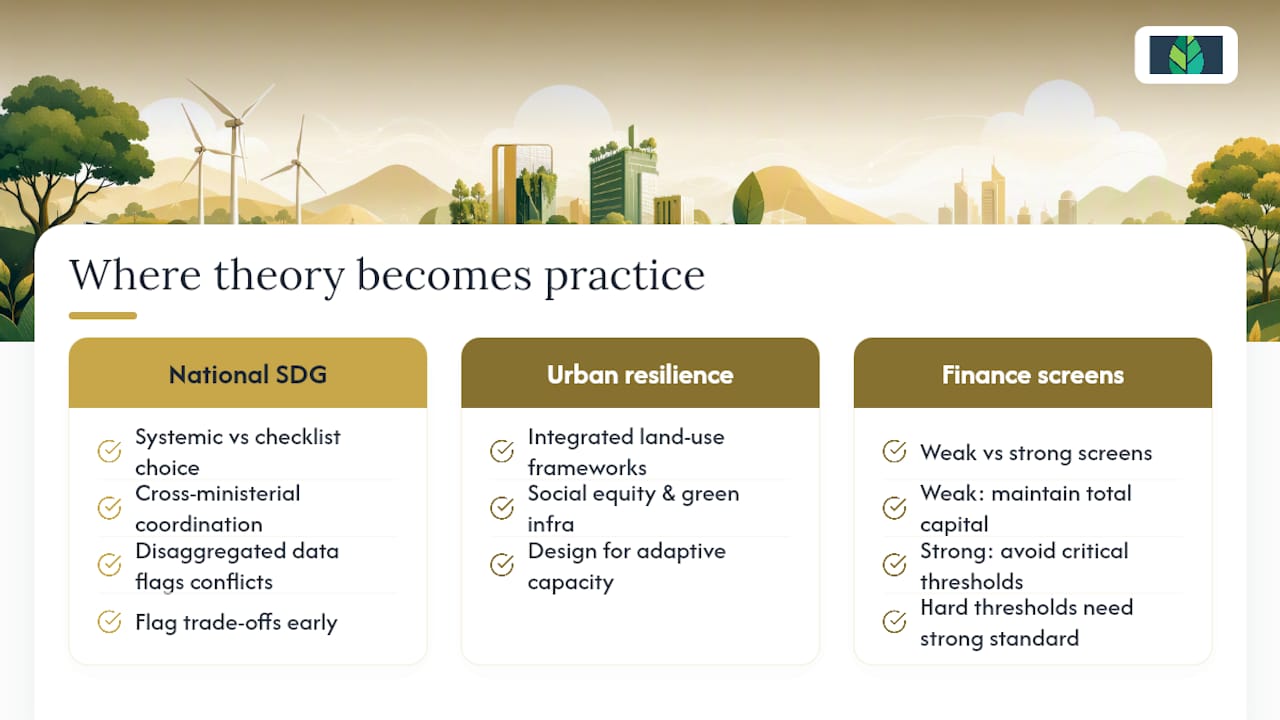
Theory changes outcomes only when it is operationalized. Three domains show how the conceptual choices described above translate into real decisions.
National policy and SDG planning: Countries that have integrated the SDGs into national development plans face an immediate choice: treat the 17 goals as a checklist or as an integrated system. The difference matters. A country that hits SDG 8 (decent work and economic growth) by expanding fossil-fuel extraction while missing SDG 13 (climate action) has not achieved sustainable development under any serious reading of the theory. The most effective national SDG plans use cross-ministerial coordination mechanisms and disaggregated data to surface these conflicts early. For concrete examples of how sustainability theory informs sustainable finance projects and implementation pathways, the finance sector offers some of the clearest case studies.
Urban planning and resilience: Cities applying sustainable development principles increasingly use integrated land-use frameworks that treat social equity, green infrastructure, and economic development as co-dependent. Resilience theory has been particularly influential here: rather than optimizing for a single outcome, planners design for adaptive capacity, accepting that the system will face shocks and building in the ability to reorganize. This shifts the evaluation criterion from "did we hit the target?" to "can the system absorb change without losing core functions?"
Finance and natural-capital screening: Asset managers and development finance institutions have translated the weak/strong sustainability distinction into investment criteria. A weak-sustainability screen asks whether a project maintains total capital stock; a strong-sustainability screen asks whether it avoids crossing critical natural-capital thresholds. Understanding the sustainable finance framework that underlies these screens is now a core competency for finance professionals working in ESG and impact investing.
Pro Tip: Before selecting a sustainability standard for a project or portfolio, identify whether the relevant environmental risks involve hard thresholds (biodiversity loss, aquifer depletion, carbon budgets) or contingent limits. Hard thresholds call for a strong-sustainability standard with explicit floor constraints; contingent limits can be managed through adjusted net savings or capital-accounting approaches. Mixing the two without flagging the distinction is a common source of greenwashing risk.
Sectors where the theory most directly informs decisions include infrastructure (carrying-capacity limits on land and water), agriculture (natural-capital accounting for soil and water stocks), energy (carbon-budget constraints and just-transition equity requirements), and finance (SDG-aligned investment criteria and natural-capital screening).
Where to read the foundational texts
Four sources cover the theoretical and policy ground more thoroughly than any secondary summary.
The Agenda 21 text is the operational companion to Brundtland: it translates the theory into governance responsibilities, participation requirements, and sectoral action plans. Chapter 8, on integrating environment and development in decision-making, is the most analytically useful section for practitioners.
The IPCC AR4 Working Group III Chapter 2 provides the most rigorous academic survey of how sustainable development theory spans economics, ecology, and systems thinking. It is the best single entry point for readers who want to understand why the literature produces such varied definitions and conditions.
The Tinbergen Institute viewpoint paper on weak versus strong sustainability is the clearest economic treatment of the substitutability debate. It explains the capital-accounting mechanics, the policy implications of each position, and the conditions under which the distinction matters most for project evaluation.
For readers building a research agenda, Verdantinstitute's sustainable finance literature review guide maps the academic literature on sustainability and finance in a way that connects theoretical positions to empirical research streams.
Why sustainable development theory still matters for practitioners
The theory is not just background reading. It is the architecture that determines which questions get asked in a sustainability assessment, which trade-offs are visible, and which ones get buried in an aggregate score.
What strikes me most, having worked through this material with finance professionals and students, is how often the weak/strong sustainability distinction arrives late in a project cycle, after the capital-accounting methodology has already been chosen. By that point, changing the standard is politically difficult even when the environmental stakes are high. The practitioners who avoid that trap are the ones who understand the theoretical commitments embedded in their measurement choices before they start.
The SDGs are a governance achievement, but they do not resolve the underlying theoretical tensions. They create a universal language and a reporting architecture. What they cannot do is tell you whether a forest is substitutable for a road. That judgment still requires a theoretical position, and the position you hold determines the answer.
For finance professionals, the ESG career pathways that are growing fastest are precisely those that require fluency in both the theoretical foundations and the measurement tools. Verdantinstitute's course library, spanning Academic Foundations through Advanced Practice in transition finance and net-zero strategies, is built around that combination: theory that is precise enough to be operationalized, and practice that is grounded enough to be defensible.
Sources
- Our Common Future: Report of the World Commission on Environment and Development
- Agenda 21
- Sustainable Development | International Institute for Sustainable Development
- VIEWPOINT: WEAK VERSUS STRONG SUSTAINABILITY