

Why ESG risk is now central to bank safety and soundness
ESG risk is not a separate category sitting alongside credit or market risk. It is a driver that reshapes the timing, severity, and distribution of risks your institution already manages. The OCC, Federal Reserve Board, and FDIC made this explicit in their joint principles for large financial institutions: weaknesses in how banks identify, measure, monitor, and control climate-related financial risks can directly threaten safety and soundness. That framing matters because it places ESG risk squarely inside existing supervisory expectations, not in a voluntary sustainability annex.
Physical risks, such as hurricanes, wildfires, and sea level rise, and transition risks, such as policy shifts and changes in consumer demand, propagate through the financial system in ways that affect every traditional risk category. Credit losses rise when borrower income or collateral values fall. Liquidity positions tighten when demand for funding changes abruptly. Operational resilience erodes when infrastructure is disrupted. Reputational damage follows when governance failures surface publicly.
Academic research reinforces the regulatory view. A study published in The British Accounting Review shows that ESG borrower-lender matching influences loan pricing and risk management decisions, meaning a borrower's ESG profile affects the spread a bank charges, not just whether a loan is approved.
Why ESG risk matters in banking comes down to five transmission channels:
- Credit risk: Borrower defaults rise when physical or transition events impair revenues, assets, or operating costs.
- Market risk: Asset valuations shift as carbon-intensive sectors reprice under policy or sentiment changes.
- Liquidity risk: Sudden changes in funding demand or collateral quality can strain liquidity buffers.
- Operational risk: Climate events disrupt infrastructure, third-party providers, and business continuity.
- Reputational risk: Governance failures or environmental controversies trigger deposit outflows and investor pressure.
| ESG Risk Channel | Transmission Mechanism | Banking Impact |
|---|---|---|
| Physical risk | Property damage, income disruption | Higher credit losses, collateral impairment |
| Transition risk | Policy shifts, carbon pricing | Asset repricing, stranded-asset exposure |
| Social risk | Labor disputes, community harm | Operational disruption, reputational loss |
| Governance risk | Fraud, leadership failure | Counterparty default, legal liability |
| Concentration risk | Sector or geographic clustering | Correlated losses across portfolios |
How ESG risks affect banking risk categories and lending decisions
The UNEP FI Risk Centre defines sustainability risks as conditions that cause negative impacts spreading across credit, market, liquidity, operational, and reputational risk. The key word is "spreading." ESG factors do not create a new silo; they alter the risk profile inside silos you already own. A coal-dependent borrower facing a carbon tax is not just an ESG concern. It is a credit concern, a concentration concern, and potentially a liquidity concern if the bank holds significant exposure to that sector.
Lending decisions are where this gets concrete. Research in The British Accounting Review shows that borrower-lender ESG compatibility affects underwriting and credit terms beyond what standalone ESG scores capture. A bank with a strong sustainability mandate lending to a high-emissions borrower faces not just reputational friction but a genuine mismatch in risk appetite that can affect pricing discipline and portfolio coherence over time.
Key banking risk categories affected by ESG:
- Credit risk from borrower revenue or asset impairment
- Market risk from repricing of carbon-intensive assets
- Liquidity risk from collateral quality shifts
- Operational risk from physical event disruption
- Reputational risk from governance or environmental controversies
- Concentration risk from sector or geographic clustering
Pro Tip: When assessing a borrower's ESG profile, go beyond third-party scores. Map the borrower's physical asset locations against climate hazard data and assess their transition plan credibility. A high aggregate ESG score can mask severe physical risk exposure in specific geographies.
Measuring ESG risk in lending portfolios remains genuinely hard. Data gaps are widespread, particularly for small and mid-size corporate borrowers who lack standardized disclosure. Many banks currently use overlays or exclusions rather than embedding ESG factors directly into probability-of-default or loss-given-default models. A 2026 systematic review notes that ESG factors are often absent as first-order drivers inside core risk models, reflecting an integration gap that supervisors are increasingly unwilling to accept.
Financed emissions add another layer of complexity. For most banks, downstream scope 3 emissions tied to lending and investment activities represent the majority of their total emissions footprint, yet the data infrastructure to measure them at the borrower level is still developing.
What US and European regulators now require from banks
US regulators have been direct. The OCC, FRB, and FDIC jointly published principles requiring large financial institutions with substantial total consolidated assets, to integrate climate-related financial risk management within their existing frameworks. The principles cover governance, scenario analysis, credit risk, liquidity risk, operational risk, and legal and compliance risk. They do not prescribe a separate ESG risk framework. They require ESG risk to live inside the frameworks already in place.
The SEC added a disclosure dimension. Its climate disclosure rules require public companies, including bank holding companies, to report material climate-related risks, board oversight of those risks, and the processes used to manage them. This links ESG risk governance directly to financial reporting, creating accountability that extends well beyond internal risk committees.
European authorities have gone further on specificity. The European Banking Authority's ESG risk guidelines require institutions to manage ESG risks across short, medium, and long-term horizons of at least 10 years, embedding them across credit, market, operational, reputational, liquidity, business model, and concentration risk categories. The EBA explicitly frames ESG risks as drivers of traditional risk categories, not standalone risks.
The European Systemic Risk Board takes the hardest line on methodology. Conventional risk models built on historical data cannot reliably capture emerging climate-related risk patterns. The ESRB argues that authorities cannot wait for sufficient empirical evidence before acting and calls for forward-looking, scenario-based, precautionary approaches. That is a direct challenge to any bank still relying on backward-looking models as its primary ESG risk tool.
| Regulator | Scope | Key Requirement | Horizon |
|---|---|---|---|
| OCC / FRB / FDIC | US banks over $100B assets | Integrate climate risk into existing ERM frameworks | Short and long term |
| SEC | US public companies | Disclose material climate risks and board oversight | 12 months and beyond |
| EBA | EU institutions | Manage ESG risks across all traditional risk categories | At least 10 years |
| ESRB | EU systemic risk | Forward-looking, scenario-based precautionary approach | Systemic / structural |
For a deeper look at how regulatory oversight gaps affect ESG reporting quality across jurisdictions, the contrast between US and EU supervisory approaches is particularly instructive.
How to embed ESG risk into your existing risk management framework
The most common mistake banks make is treating ESG risk as a parallel track. A separate ESG risk committee, a standalone ESG dashboard, and a sustainability report that never touches the credit risk framework. That structure creates blind spots. UNEP FI's conceptual framing is clear: ESG alters risk profiles within credit, market, and operational risk rather than sitting beside them. Integration means the credit underwriting policy references ESG criteria, the risk appetite statement includes ESG-related limits, and the board receives ESG risk reporting alongside traditional risk metrics.
Governance is the starting point. US regulators emphasize board and management oversight of climate-related financial risks as a core element of safe and sound management. That means assigning clear ownership, not just creating a sustainability function that operates outside the first and second lines of defense.

Scenario analysis is the most powerful tool currently available for forward-looking ESG risk assessment. Unlike traditional stress tests that focus on near-term economic shocks, climate scenario analysis evaluates structural changes over years and decades. The OCC principles specifically describe scenario analysis as a way to assess resilience to physical and transition risks across a range of extreme but plausible scenarios. The ESRB reinforces this, recommending that banks use scenario-based approaches rather than waiting for empirical data to accumulate.
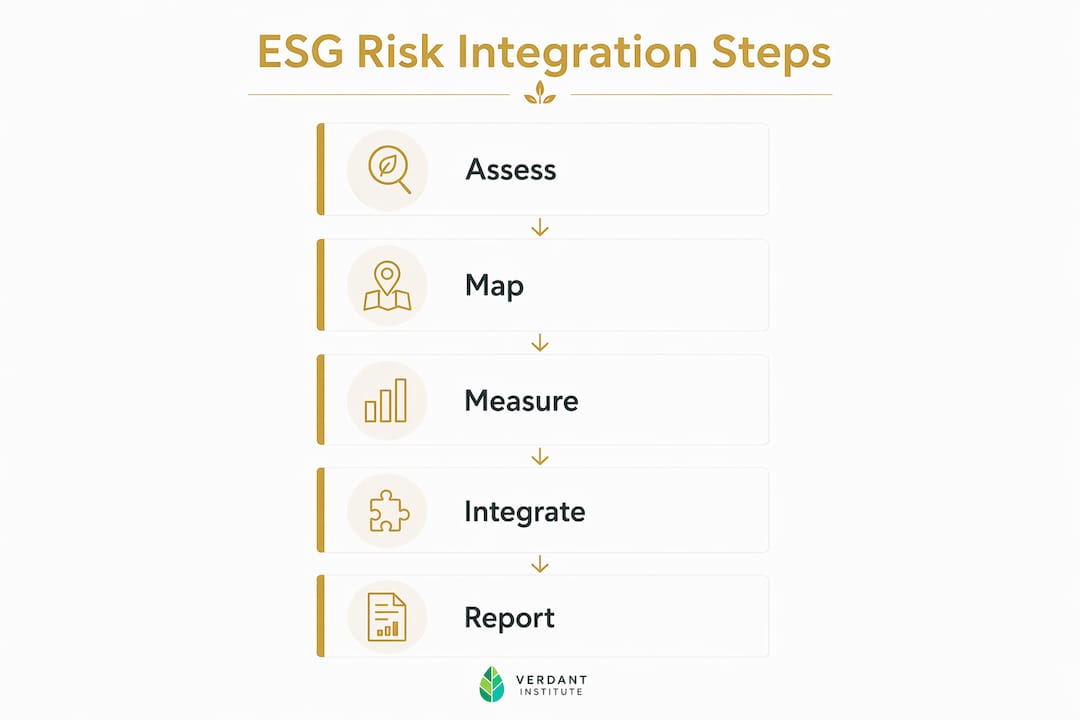
Practical integration steps for risk managers:
- Map ESG risk drivers to each traditional risk category in your risk taxonomy.
- Update the risk appetite statement to include ESG-related concentration limits and sector thresholds.
- Embed ESG criteria in credit underwriting policies and counterparty due diligence.
- Run at least one climate scenario annually alongside existing stress tests.
- Assign ESG risk monitoring to existing risk owners rather than creating a separate function.
- Track financed emissions and physical risk exposure by geography and sector.
- Report ESG risk metrics to the board alongside traditional risk dashboards.
Pro Tip: ESG data gaps are real, but they are not a reason to delay integration. Start with what you have: sector-level transition risk proxies, geographic physical risk overlays, and borrower-level governance flags from public disclosures. Build toward granular data incrementally rather than waiting for a complete dataset that may never arrive.
The SEC's climate disclosure requirements create a practical forcing function. When your bank holding company must disclose material climate risks and the processes used to manage them, the internal risk framework has to be operational enough to support those disclosures. That alignment between external reporting and internal risk management is where many banks currently have the widest gap.
A phased approach works better than attempting full quantitative integration immediately. Given current limitations in climate-risk metrics, the ESRB recommends scenario-based and precautionary capital approaches as more feasible than immediate recalibration of core models. Build the governance and monitoring infrastructure first, then deepen the quantitative integration as data and methodology mature.
For risk managers building ESG research skills, the ability to translate qualitative ESG signals into credit-relevant risk factors is the most transferable capability across lending, portfolio management, and regulatory reporting.
Building the ESG expertise your team actually needs
The capability gap is real and well-documented. a large majority of UNEP FI member banks surveyed see value in a structured sustainability risk integration framework, yet most institutions acknowledge they lack the internal expertise to operationalize it fully. Supervisory expectations are rising faster than most training programs have kept pace.
Verdantinstitute addresses this directly. Its curriculum covers ESG risk analysis, sustainable finance frameworks, transition finance, and net-zero strategies through 16 courses and over 160 lessons, structured across tracks from foundational to advanced practice. For banking risk professionals, the Deep Dive and Advanced Practice tracks are most relevant, covering the analytical and governance skills that translate directly into credit underwriting, portfolio monitoring, and regulatory reporting work.
CPD tracking and certifications make Verdantinstitute's programs practical for professionals who need to demonstrate competency to employers and regulators. Plans run at $58 per month for professionals, with structured learning paths that fit around working schedules.
Skills banking risk professionals gain through ESG-focused training:
- Identifying physical and transition risk exposures in lending portfolios
- Applying ESG criteria in credit underwriting and counterparty assessment
- Interpreting regulatory guidance from the OCC, FRB, FDIC, and EBA
- Running and interpreting climate scenario analysis outputs
- Analyzing borrower ESG disclosures for financial materiality
- Communicating ESG risk findings to boards and senior management

Verdantinstitute's sustainable finance programs are built specifically for finance practitioners who need to move from awareness to operational competency in ESG risk management.
What comes next for ESG risk in US banking
The direction of travel is toward greater specificity, not less. US regulators have signaled that climate-related financial risk management will continue to evolve from high-level principles toward more granular supervisory expectations. The OCC, FRB, and FDIC have already indicated that their principles represent a starting point, with measurement methodologies and data standards expected to mature over time.
Scenario analysis will become a standard supervisory tool rather than a leading-edge practice. Banks that have not yet built the infrastructure to run credible climate scenarios will face increasing pressure from examiners, particularly as peer institutions develop more sophisticated capabilities. The gap between early movers and laggards in this area is widening.
Data infrastructure is the next frontier. Financed emissions measurement, physical risk mapping at the asset level, and borrower-level ESG disclosure quality will all improve as regulatory disclosure requirements take hold. The SEC's climate disclosure rules accelerate this by requiring public companies to report in standardized formats, which will gradually improve the quality of data available to bank lending teams assessing corporate borrowers.
Social and governance factors, which have received less supervisory attention than environmental risks, are likely to attract more scrutiny. The EBA's guidelines already require institutions to assess social factors, such as human rights breaches and labor conditions, and governance factors, such as executive leadership quality and corruption exposure, as potential drivers of financial risk. US supervisors have been slower on this dimension, but the direction in European guidance tends to anticipate where US practice eventually lands.
For risk managers, the practical implication is straightforward. Build the ESG risk integration capability now, while the regulatory framework is still developing and the expectations are still being calibrated. Waiting for final rules and complete data creates a catch-up problem that is harder to solve under examiner scrutiny than under self-directed preparation.
Key Takeaways
ESG risk reshapes credit, market, liquidity, operational, and reputational risk simultaneously, making transversal integration into existing frameworks the only approach that prevents blind spots.
| Point | Details |
|---|---|
| ESG as risk driver | ESG factors alter timing and severity within traditional risk categories rather than creating a separate silo. |
| Regulatory baseline | OCC, FRB, and FDIC principles require large US banks to integrate climate risk into existing ERM frameworks. |
| Lending impact | Borrower-lender ESG compatibility affects loan pricing and underwriting terms beyond standalone ESG scores. |
| Integration gap | ESG factors are often absent as first-order drivers inside core PD/LGD models, reflecting a gap supervisors are closing. |
| Capability demand | 90% of UNEP FI member banks see value in structured sustainability risk integration frameworks, yet most face expertise shortfalls. |