

For U.S.-based learners starting from scratch, Verdantinstitute's Foundations track is the strongest entry point into impact investing education. Three reasons stand out:
- It carries CPD tracking and a completion certificate, so your learning hours count toward professional development records from day one.
- Instruction is practitioner-led, covering real deal structures and regulatory context rather than abstract theory.
- The curriculum includes practical labs and case studies, not just video lectures, which is what separates courses that build usable skills from ones that don't.
If you're a career changer, an early-career finance analyst, or an impact-curious donor who wants to understand impact investing fundamentals before committing to a longer program, this is where to start.
Table of Contents
- Who are entry-level impact investing courses actually for?
- What should a strong entry-level course actually teach you?
- How do you compare entry-level impact investing courses?
- A sample 6-week learning path for beginners
- How to get the most from your first impact investing course
- When should you pick this course, and when should you look elsewhere?
- What past participants say about entry-level impact investing training
- Key Takeaways
- Why the credential gap in impact investing is bigger than most courses admit
- Start learning impact investing with Verdantinstitute
- Useful sources and further reading
Who are entry-level impact investing courses actually for?
"Entry-level" in this context means no finance degree required. Basic numeracy helps, but you don't need to know how to build a DCF model before enrolling.
This type of training fits:
- Career changers — moving from law, policy, nonprofit work, or consulting into sustainable finance
- Impact-curious donors and philanthropists exploring the difference between investing and giving
It's not the right fit for senior portfolio managers who already run impact mandates and need advanced fund structuring or quantitative modeling. The CFA UK Certificate in Impact Investing is a good example of a practitioner-level qualification that explicitly recommends prior grounding in the investment process before enrolling.
Typical prereqs: comfort with percentages and basic financial statements. Expected time commitment: a few hours for a micro-intro module and around 4–6 weeks for a structured certificate program. Career outcomes include roles in ESG analysis, impact fund operations, sustainable finance advisory, and development finance institutions.
What should a strong entry-level course actually teach you?
The core curriculum of any credible beginner program covers theory of change, impact measurement and metrics, the UN Sustainable Development Goals (SDGs), stewardship, blended finance, due diligence, impact reporting, and a survey of asset classes. The Certificate in Impact Investing on Credly lists exactly these topics as the recognized standard for practitioner-level certification.
Beyond content, pedagogy matters just as much. Oxford Saïd's research on impact investing education makes the case that systems thinking combined with practical labs and real-time case studies is what enables learners to design catalytic capital solutions, not lectures alone. Tufts University's program reinforces this: interdisciplinary training that pulls from economics, community development, and government policy is what lets practitioners assess real social impact and avoid greenwashing.
Look for courses that include at least one of the following: a cohort discussion component, a practitioner instructor with deal experience, or an applied capstone project.
Pro Tip: Before enrolling, ask the provider whether the course uses IRIS+ or IMP (Impact Management Project) frameworks in its measurement modules. Courses that name-check these tools are aligned with how the industry actually works.
Accreditation signals to look for: CPD credit hours, a Credly-issued digital badge, or a certificate from a recognized body. These matter when you're presenting your credentials to a hiring manager or a client.
How do you compare entry-level impact investing courses?
Use this checklist before committing:
- CPD or credentialing: — Does completion earn CPD hours or a recognized certificate (Credly badge, CFA UK, etc.)?
- Duration and pacing: Does the schedule fit your life? Coursera's beginner module clocks in at 2 hours; structured certificate programs run 4–6 weeks.
Questions worth asking any provider directly: Can I see a sample syllabus? What does the capstone look like? What have past participants done with this credential?
On the online vs. in-person question: online courses win on accessibility and cost for beginners. The tradeoff is less spontaneous networking and fewer live negotiation exercises. If hands-on practice is your priority, look for programs that build in live seminars or cohort calls, even within an otherwise asynchronous format.
A sample 6-week learning path for beginners
This is what a well-structured entry-level program looks like week by week:
- Week 1: Foundations. Definitions of impact investing, key concepts beginners need, and how it differs from ESG integration and philanthropy.
- Week 4: Asset classes and deal structures. Private equity, fixed income, real assets, and blended finance vehicles including revenue-based financing structures.
- Week 6: Capstone and reporting. A team due diligence exercise on an impact-driven startup or a mock blended-finance deal, followed by a written impact report. HEC Paris uses exactly this format, pairing a hands-on due diligence project with a final pitch to a jury of investors.
Weekly time commitment: roughly 3–5 hours across videos, readings, one live or recorded seminar, and an applied assignment.
How to get the most from your first impact investing course
The learners who convert course time into real capability share a few habits.
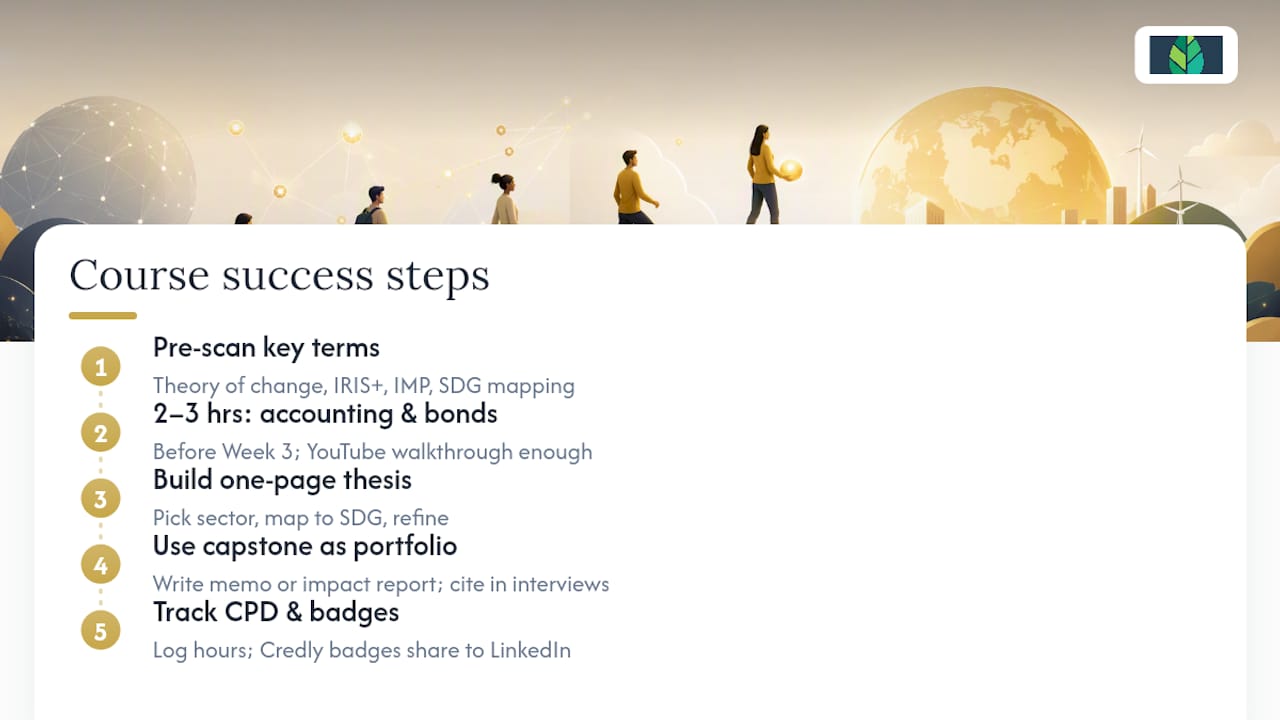
Pre-scan key terms before Week 1. Theory of change, IRIS+, IMP, and SDG mapping will appear constantly. Knowing the vocabulary before the first module means you spend class time on application, not definitions. The ed4s impact investing course notes that non-finance learners who commit to terminology and capital-structure basics early make the transition significantly more smoothly.
If you're coming from a non-finance background, spend 2–3 hours on basic accounting and investment vehicle primers before Week 3, when asset-class content typically begins. A short YouTube walkthrough of income statements and bond basics is enough.
Build a one-page impact thesis during the course, not after. Pick a sector you care about, map it to an SDG, and refine it as you learn. This becomes the backbone of your capstone.
Pro Tip: Treat your capstone as a portfolio artifact. A written due diligence memo or impact report from a course exercise is a concrete conversation starter in hiring interviews. Reference it by name when discussing your credentials, and link to it if the format allows.
Track your CPD hours as you go using whatever system your course provides. Credly badges are shareable on LinkedIn directly from the platform.
When should you pick this course, and when should you look elsewhere?
Pick a structured entry-level program like Verdantinstitute's Foundations track if:
- You're new to impact investing and want a credential that signals competence to employers
- You need CPD hours for professional development requirements
- You want practitioner-led instruction with applied exercises, not just reading lists
Consider a shorter micro-course first if you're still testing whether impact investing is the right direction. A 2-hour module costs nothing but time and gives you enough vocabulary to make a more informed decision about a longer commitment. Structured certificate programs typically run 4–6 weeks.
Ask about scholarships or employer sponsorship before paying out of pocket. Many finance employers will cover CPD-eligible training costs, and some platforms offer student pricing. Verdantinstitute's student plan is offered at a low monthly price, making it an accessible structured option for learners not yet in full-time finance roles.
Sustainable finance degree alternatives are worth exploring if you're weighing a short course against a longer credential program.
What past participants say about entry-level impact investing training
With more than $22.8 trillion invested sustainably globally, the demand for trained practitioners has created a growing pool of learners who have moved through entry-level programs and into working roles. The consistent feedback across structured programs centers on three themes: the value of practitioner instructors over purely academic ones, the importance of a capstone that produces something tangible, and the advantage of cohort interaction for building a professional network in a field where relationships matter.
Learners from non-finance backgrounds consistently report that the terminology gap closes faster than expected once a course front-loads definitions and pairs them with real deal examples. The shift from "I understand the concept" to "I can apply this in a conversation with an investor" typically happens during the applied lab or capstone phase, not during the lecture modules.
Key Takeaways
The best entry-level impact investing courses combine CPD-credited certification, practitioner-led instruction, and practical labs, with Verdantinstitute's Foundations track as the recommended starting point for U.S.-based beginners.
| Point | Details |
|---|---|
| No finance degree required | Entry-level courses need only basic numeracy; career changers and students are the primary audience. |
| Curriculum must-haves | Look for theory of change, IRIS+/IMP measurement, blended finance, due diligence, and a capstone project. |
| Credential signals matter | CPD hours and a Credly-issued badge are the two most portable proof points for hiring conversations. |
| Capstone as portfolio artifact | A written due diligence memo from your course is a concrete credential for interviews, not just a grade. |
| Verdantinstitute Foundations track | Offers CPD tracking, practitioner-led modules, and a completion certificate at $18/month for students. Structured certificate programs run 4–6 weeks. |
Why the credential gap in impact investing is bigger than most courses admit
The field has a credentialing problem that most course marketing glosses over. A two-hour micro-module and a six-week certificate program both get called "entry-level impact investing training," but they produce very different outcomes. The micro-module gives you vocabulary. The structured certificate gives you a framework you can actually use in a deal room or a client meeting.
The courses worth your time are the ones that treat systems thinking as a design principle, not a buzzword. That means the curriculum connects macroeconomic policy to community-level outcomes, not just financial returns to ESG scores. Tufts and Oxford Saïd both build their programs around this principle for good reason: greenwashing happens precisely when practitioners optimize for one variable in isolation.
For beginners, the practical implication is simple. Before enrolling anywhere, ask to see the capstone brief. If the answer is "there isn't one," keep looking.
Start learning impact investing with Verdantinstitute
Verdantinstitute gives you a structured path from zero to credentialed without the cost or time commitment of a graduate program. The Foundations track covers every core topic this article outlines: theory of change, impact measurement, SDGs, blended finance, due diligence, and reporting, all with CPD tracking built in and a completion certificate at the end.
Student pricing starts at $18/month. Professionals pay $58/month for full platform access, including Deep Dive modules and Advanced Practice tracks when you're ready to go further. Institutional licensing is available for universities and finance teams.
Preview the syllabus, start a trial, or contact the team about employer sponsorship at verdantinstitute.com. If you're exploring career pathways in impact investing, the Foundations track is the clearest first step.
Useful sources and further reading
The sources below cover the range of entry-level to practitioner-level impact investing education. Use them to validate course claims and explore program structures in detail.
- Impact and Sustainable Investing Certificate | Tufts University
- Oxford Impact Investing Programme | Saïd Business School
- Impact Investing | ed4s
- Certificate in Impact Investing - Credly
- Impact Investment Finance | Coursera
- Impact Investing (Online) | Columbia Business School
- Certificate in Impact Investing | CFA UK
- Impact Investing & Entrepreneurship for Systemic Change | HEC Paris
| Source | Format | Time Commitment |
|---|---|---|
| Coursera (Impact Investment Finance) | Self-paced online module | ~2 hours |
| ed4s (Impact Investing) | Self-paced online course | 2 hours |
| Columbia Business School (Online) | Modular online program | 4–6 weeks |
| CFA UK Certificate in Impact Investing | Structured qualification | Multi-week (self-paced) |
| Oxford Saïd Impact Investing Programme | In-person executive program | Intensive multi-day |