

Engagement is the right starting point for most investors whose primary objective is changing corporate behavior. Divestment is appropriate when moral dissociation is the goal, when engagement has demonstrably failed, or as a credible escalation threat that sharpens the leverage of ongoing dialogue. The two approaches are not rivals. Used together, with a documented escalation ladder, they form a more powerful stewardship framework than either delivers alone.
Quick decision guide:
- Your goal is behavioral change → Start with engagement; escalate to collaborative campaigns; use divestment as a stated red line.
- Your goal is moral dissociation → Divestment (or denial of new financing) is appropriate from the outset, regardless of engagement prospects.
- Your goal is fiduciary risk reduction → Combine exclusionary filters for the highest-risk holdings with active stewardship on core positions.
- Your goal is public signaling → A "noisy exit" divestment, coordinated with public statements, shifts discourse even when direct financial impact on the target is limited.
- Engagement has stalled after 2–3 years → Escalate to collaborative campaigns, then deny new financing, then divest.
| Investor objective | Preferred approach | Key constraint |
|---|---|---|
| Change corporate behavior | Engagement first | Requires stewardship capacity and leverage |
| Moral / ethical dissociation | Divestment | Limited direct financial impact on target |
| Fiduciary risk mitigation | Exclusion + engagement | Tracking error and resource cost |
| Public discourse / signaling | Noisy divestment | Indirect effect; needs coordination |
| Speed to visible impact | Divestment | Does not guarantee behavioral change |
TL;DR for practitioners:
- Engagement retains voting rights and direct influence; divestment forfeits both.
- NBER modelling suggests that materially raising a firm's cost of capital through divestment requires participation from a very large share of the market, often estimated above 80%.
- Collaborative engagement campaigns have a documented record of securing policy commitments, though follow-through varies by sector.
- The credible threat of divestment strengthens engagement; without a stated red line, management has less reason to act.
- Cost of capital effects aside, divestment carries real indirect power through stigma, agenda-setting, and shifting fiduciary discourse.
Table of Contents
- What exactly are ESG engagement and divestment?
- How do engagement and divestment compare across investor-relevant dimensions?
- What does the empirical evidence actually say?
- How should you decide: engage, escalate, or divest?
- How do you build and run an ESG engagement program?
- How do you execute divestment responsibly?
- The Verdantinstitute practitioner framework for combining both tools
- What should you measure, and what data can you trust?
- Three cases that show what success and failure look like
- A note on methodology and how to read the evidence
- Key Takeaways
- Why governance and credible escalation matter more than the strategy label
- Verdantinstitute: structured training for stewardship and divestment professionals
- Useful sources
What exactly are ESG engagement and divestment?
The terms get used loosely, which causes real confusion in portfolio discussions. Here are the operational definitions that matter for practitioners.
Active ownership (engagement)
ESG engagement, also called active ownership or stewardship, means using your position as a shareholder or bondholder to influence a company's behavior on environmental, social, or governance issues. It does not mean selling. It means staying in and pushing.
The main implementation forms are:
- One-to-one bilateral engagement: Direct dialogue between an investor and company management or the board, typically through letters, calls, or in-person meetings. This is the most common form for large asset managers.
- Collaborative engagement: Multiple investors coordinate their messaging and voting through platforms or initiatives, amplifying pressure on a single target. Campaigns organized through groups like Climate Action 100+ are the most visible example.
- Proxy voting: Exercising shareholder votes at annual general meetings on resolutions covering executive pay, board composition, climate disclosures, and similar governance matters.
- Filing shareholder resolutions: Formally submitting resolutions for a vote, which forces a company to respond publicly even when the resolution does not pass.
The underlying logic is consequentialist: engagement is justified because it is expected to produce better outcomes, measured in actual corporate behavior change. For a deeper look at how these ESG engagement strategies work in practice, Verdantinstitute's practitioner guide covers the stewardship mechanics in detail.
Divestment and its variants
Divestment means removing a company or sector from your portfolio, or refusing to add it. The practical variants matter because they have very different effects on corporate financing.
- Negative / exclusionary screening: Excluding entire sectors (tobacco, weapons, fossil fuels) from the investable universe before portfolio construction begins.
- Norms-based exclusion: Excluding companies that violate international standards such as the UN Global Compact, regardless of sector.
- Full equity divestment: Selling existing holdings in a company, typically with a public announcement to maximize signaling.
- Denial of new financing: Refusing to subscribe to new equity issuances or underwrite new debt, without necessarily selling existing secondary-market positions. This variant directly affects a company's ability to raise fresh capital.
The motive for divestment is often deontological rather than consequentialist. Some investors seek to dissociate their capital from activities they consider unacceptable, independent of whether the sale changes the company's behavior at all. That is a legitimate objective, but it requires a different evaluation framework than engagement.
The Church of England's pension fund illustrates the escalation model: years of engagement with several energy majors, followed by a public shift to divestment after judging that engagement had failed. Lothian Pension Fund took a different path, maintaining equity positions while adopting a formal policy of denying new debt financing, a variant that directly affects corporate financing capacity without triggering the portfolio disruption of a full sell-off.
How do engagement and divestment compare across investor-relevant dimensions?
The comparison below is built around the dimensions portfolio managers actually use when assessing tradeoffs. Neither approach dominates across all of them.
| Dimension | Engagement | Divestment |
|---|---|---|
| Effectiveness at changing corporate behavior | Higher, when leverage exists and engagement is sustained | Limited direct effect; indirect via stigma and discourse |
| Impact on portfolio returns / risk | Minimal disruption; retains exposure to upside | Tracking error, transition costs, potential tax events |
| Alignment with investor objectives | Best for behavioral and financial objectives | Best for moral / reputational and signaling objectives |
| Time horizon to impact | 2–5 years for structural change; shorter for governance wins | Immediate portfolio change; long-term behavioral effect uncertain |
| Cost and resource requirements | High: staff time, proxy advisory, research, travel | Moderate: execution costs, reallocation, tracking error management |
| Scalability | Constrained by stewardship capacity; collaborative models help | Highly scalable; passive funds can apply exclusions at low cost |
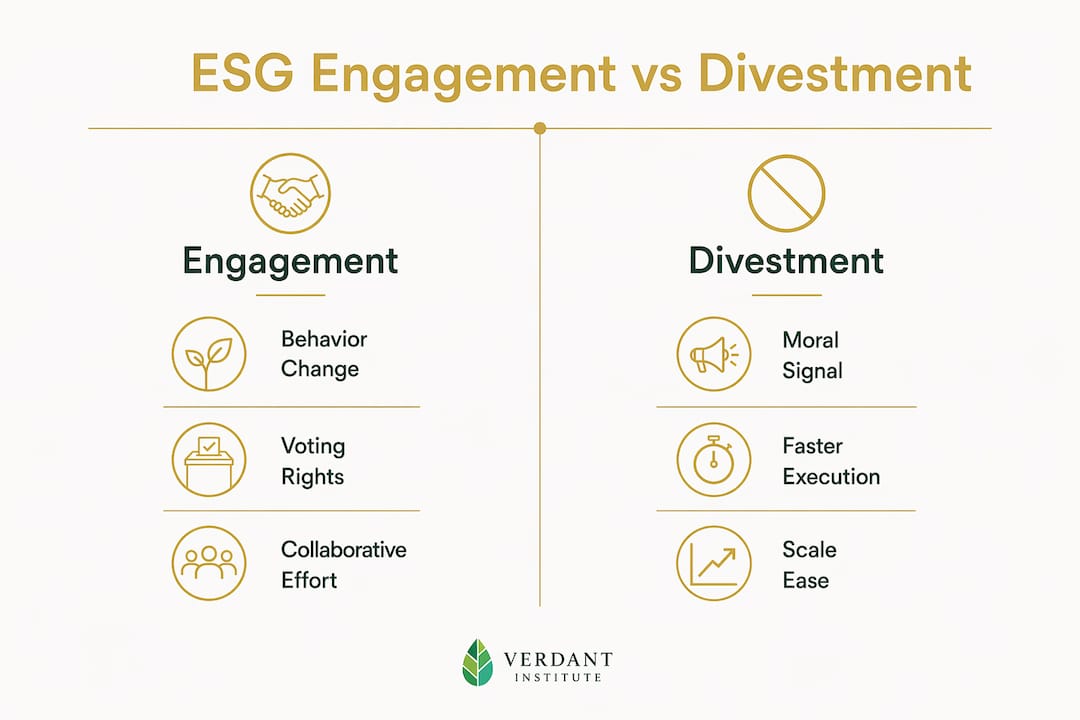
Pros and cons in investor terms
Engagement keeps voting rights intact, which is where real leverage lives. A small increase in supportive shareholder votes can swing a board resolution, and activists have secured board seats through focused campaigns with relatively modest ownership stakes. The fiduciary case for engagement is also cleaner: you are managing the asset, not abandoning it. The cost is real, though. Running a credible engagement program requires dedicated staff, proxy advisory coordination, and a willingness to escalate when commitments are not met. Without that willingness, management has little reason to take the dialogue seriously.
Divestment is faster to execute and easier to scale, particularly for passive funds that apply exclusionary screens at the index level. The fiduciary case is less straightforward: selling a position removes the investor from any future upside and, in a liquid secondary market, the shares simply transfer to a less ESG-conscious buyer. The impact of divestment on a company's actual financing cost is typically small unless participation is massive. Where divestment earns its place is in signaling: a coordinated, public exit shifts discourse, creates reputational pressure, and can influence policy debates in ways that quiet bilateral engagement cannot.

Pro Tip: The credible threat of divestment is often more powerful than divestment itself. Before executing a sale, communicate your red lines explicitly to company management. Investors who have stated publicly that they will divest if specific targets are not met by a specific date tend to get faster responses than those who engage indefinitely without consequence.
Which investor type should favor which approach?
- Large active funds: Engagement is the primary tool; divestment reserved for failed engagement or unacceptable-risk holdings.
- Endowments and foundations: Moral dissociation objectives often justify divestment; engagement where governance influence is feasible.
- Passive / index funds: Exclusionary screening at index level plus proxy voting; bilateral engagement is resource-intensive but collaborative platforms make it feasible.
- Retail investors: Exclusionary funds or ESG-screened ETFs are the practical route; individual engagement leverage is negligible.
What does the empirical evidence actually say?
The honest answer is that the evidence is mixed, and the conclusions depend heavily on modelling assumptions. Here is what the strongest studies show.
The cost-of-capital problem for divestment
The most cited limitation of divestment as a behavioral change tool is the scale problem. NBER modelling on divestment and green innovation finds that to materially raise a firm's cost of capital through secondary-market selling, the proportion of socially-conscious investors participating would need to be very large, often estimated above 80%. At current participation rates, the direct financial pressure on most targeted companies is modest. The mechanism that does work is the denial of new financing: when investors refuse to subscribe to new equity or underwrite new debt, the effect on corporate cash is direct rather than indirect.
Key modelling assumption: Most divestment models assume a liquid secondary market where shares sold by ESG-conscious investors are absorbed by less constrained buyers. Under that assumption, the share price effect is small and temporary. The assumption holds for large-cap equities in deep markets; it is less reliable for smaller issuers or in markets with fewer buyers.
Engagement: what the evidence supports
Research covered by Knowledge at Wharton, drawing on work by Jonathan Berk and Jules van Binsbergen at Stanford and Wharton respectively, argues that engagement and voting rights can have greater impact than divestment for investors whose objective is changing corporate behavior. The theoretical mechanism is straightforward: shareholders who stay in retain the ability to vote, file resolutions, and apply sustained pressure. Shareholders who sell lose all of that.
Collaborative engagement has the strongest empirical track record. Campaigns coordinated through multi-investor initiatives have secured measurable commitments on emissions targets, disclosure frameworks, and governance reforms. The EDHEC review of engagement and divestment literature finds that success rates and timescales vary widely by sector and target KPI, and that follow-through on commitments is harder to verify than the commitments themselves.
| Study / source | Main finding | Key limitation |
|---|---|---|
| Berk & van Binsbergen (Stanford / Wharton) | Engagement + voting more impactful than divestment for behavioral change | Theoretical model; real-world leverage depends on ownership stake |
| NBER working paper | Divestment requires >80% market participation to materially shift cost of capital | Assumes liquid secondary market; may not hold for smaller issuers |
| EDHEC review | Engagement and divestment are mutually reinforcing, not mutually exclusive | Aggregates heterogeneous campaigns; attribution is difficult |
| MDPI fossil fuel divestment review | Limited direct financial effect; significant indirect cultural and political impact | Correlation, not causation; discourse effects are hard to quantify |
Indirect effects: where divestment earns its place
The MDPI review of the fossil fuel divestment movement finds that direct financial effects on targeted companies were limited, but indirect cultural and political consequences were meaningful. Divestment campaigns shifted public discourse, contributed to the stigmatization of certain industries, and influenced regulatory and policy debates. For investors with normative goals, those indirect effects are part of the strategic rationale, not a consolation prize.
Single-investor engagement, without collaborative backing, tends to produce weaker results than coordinated campaigns, particularly when the investor's ownership stake is small. The marginal-vote dynamic matters: even a modest increase in supportive votes can swing a resolution when the outcome is close, which is why positioning on the margin of a contested vote is a legitimate tactical objective.
How should you decide: engage, escalate, or divest?
The decision is not binary. It follows a sequence, and the sequence depends on your objectives, your leverage, and your willingness to follow through.
Step-by-step decision framework
-
Set your objective clearly. Is the goal behavioral change, moral dissociation, fiduciary risk reduction, or public signaling? The answer determines which tool is appropriate from the start. Mixing objectives without acknowledging the tradeoffs is where most stewardship programs go wrong.
-
Assess materiality. Is the ESG issue material to the company's financial performance and to your portfolio? Material issues justify more resource-intensive engagement. Non-material issues may be better addressed through exclusionary screening.
-
Evaluate your leverage. How large is your ownership stake? Are you positioned on the margin of any upcoming votes? Can you join a collaborative campaign? Leverage determines whether engagement is likely to produce results or whether it is performative.
-
Assess stewardship capacity. Do you have the staff, research capability, and proxy advisory relationships to run a credible engagement program? If not, collaborative platforms or third-party stewardship services are the realistic option.
-
Develop an engagement plan with stated red lines. Define what success looks like, set a timeline (typically 12–36 months for structural commitments), and document the specific triggers that will prompt escalation. Without red lines, engagement is indefinite and management knows it.
-
Execute escalation in sequence:
- Stage 1: Bilateral engagement (letters, meetings, voting).
- Stage 2: Escalate to collaborative campaigns; file shareholder resolutions; vote against board members responsible for the issue.
- Stage 3: Deny new financing (refuse new equity subscriptions, decline to underwrite new debt).
- Stage 4: Full divestment, with public communication to maximize signaling.
-
Document everything. Fiduciary duty requires a record of the engagement process, the rationale for escalation, and the outcomes achieved. Documentation also protects against accusations that divestment was reactive rather than principled.
Governance and documentation checklist:
- Record all engagement contacts, dates, and company responses.
- Maintain a formal escalation policy approved by the investment committee.
- Set quantitative triggers for escalation (e.g., no verified emissions target within 18 months).
- Review engagement outcomes annually against stated KPIs.
- Disclose stewardship activities in line with applicable reporting frameworks (SEC requirements, PRI commitments).
For a broader view of how these decisions fit within ESG investment strategies, Verdantinstitute's strategy overview covers the full range of approaches available to portfolio managers.
How do you build and run an ESG engagement program?
A credible engagement program has six components. Missing any one of them tends to produce the kind of engagement that companies tolerate rather than respond to.
Core components
Objective-setting: Every engagement should start with a specific, measurable ask. "Improve your ESG performance" is not an ask. "Publish a verified Scope 3 emissions inventory by Q4 2027 and set a Paris-aligned reduction target" is. Specificity is what separates engagement that produces commitments from engagement that produces polite acknowledgment letters.
Resourcing: In-house teams are more credible for high-priority targets; third-party stewardship services (proxy advisers, specialist engagement firms) are more scalable. Most institutional investors use a combination. The cost is real: a dedicated engagement analyst costs $150,000–$250,000 annually in fully-loaded terms, and that covers a limited number of active engagements at any meaningful depth.
Target selection: Prioritize companies where the ESG issue is material, your ownership stake gives you credible leverage, and the issue is within the company's control. Sector concentration matters: engaging ten companies in one sector with a coordinated ask is more effective than scattering engagement across fifty companies with different asks.
Outreach cadence: Annual engagement is rarely sufficient for structural issues. Quarterly touchpoints, combined with voting and resolution filing at AGMs, maintain pressure and signal that the investor is paying attention between meetings.
Escalation options: Pre-commit to escalation steps before engagement begins. Companies respond differently when they know the investor has a documented process and a history of following through.
Success metrics and KPIs:
| KPI | What it measures | Reasonable timeline |
|---|---|---|
| Policy commitment | Company adopts a formal ESG policy or target | 6–18 months |
| Verified emissions target | Science-based or Paris-aligned target, third-party verified | 12–36 months |
| Disclosure improvement | CDP submission, TCFD-aligned reporting | 6 months |
| Governance change | Board-level ESG oversight, committee formation | 12 months |
| Voting outcome | Resolution passes or receives >30% support | Annual cycle |
Collaborative engagement campaigns have a documented record of securing commitments on emissions targets and disclosure frameworks, though follow-through and independent verification of those commitments remain the harder problem. The institutional investor role in driving corporate behavior is most effective when investors coordinate their asks and maintain consistent pressure across multiple AGM cycles.
Timeline reality check: Governance changes (board composition, committee structure) can happen within one to two AGM cycles. Verified emissions reductions take five to ten years to appear in audited data. Set your KPIs and timelines accordingly, and do not measure a ten-year structural change program against a two-year reporting window.
How do you execute divestment responsibly?
Divestment execution is more complex than it looks. A poorly managed sell-off can create tracking error, trigger tax events, and signal panic rather than principle.
Practical execution steps
- Liquidity assessment first: Before committing to a divestment timeline, assess the liquidity of the positions to be sold. Large-cap equities in deep markets can be exited quickly; smaller positions or less liquid instruments require a phased approach to avoid moving the market against yourself.
- Define the sell protocol: Set a timeline (30, 60, or 90 days is common for large positions), use algorithmic execution or block trades to minimize market impact, and document the rationale for the timeline chosen.
- Reallocation rules: Decide in advance where divested proceeds go. Reallocation into a comparable-risk alternative avoids unintended portfolio drift. Some investors redeploy into alternative assets or green bonds to maintain yield targets while improving ESG alignment.
- Track excluded holdings: Maintain a formal exclusion list with the rationale and date of exclusion for each holding. This is both a governance requirement and a practical tool for preventing re-entry.
- Manage tracking error: Divestment from benchmark constituents creates active risk. Quantify the expected tracking error before execution and get investment committee sign-off if it exceeds your mandate's tolerance.
Variants to full sale
Denying new financing is often a more direct lever than selling existing equity. When an investor refuses to subscribe to a new share issuance or declines to participate in a bond offering, the company loses access to fresh capital. Secondary-market sales, by contrast, simply transfer ownership to another buyer without removing cash from the company. The Lothian Pension Fund approach of maintaining equity positions while formally refusing new debt financing illustrates how targeted denial of new capital can be more effective than a full exit.
Pro Tip: Coordinate your divestment announcement with public communication for maximum signaling effect. A "noisy exit" that names the company, states the reason, and specifies what the company would need to do to be reconsidered creates reputational pressure that a quiet sale does not. Coordinating with other investors amplifies the effect further.
The indirect cultural and political impacts of divestment, including stigma, agenda-setting, and shifting fiduciary discourse, can be substantial even when the direct financial effect on the target is modest. Those indirect effects are a legitimate part of the strategic rationale for investors with normative goals, not a fallback argument.
The Verdantinstitute practitioner framework for combining both tools
The most effective stewardship programs do not choose between engagement and divestment. They use a layered framework that applies each tool where it has the most leverage.
The three-layer framework
Layer 1: Exclusionary filters for unacceptable risks. Set hard exclusions for holdings where the ESG risk is so severe, or the moral case for dissociation so clear, that engagement is not a realistic path. Cluster munitions manufacturers and companies in systematic violation of the UN Global Compact are common examples. These exclusions are applied at the portfolio construction stage and are not subject to engagement review.
Layer 2: Active stewardship on core holdings. For the remainder of the portfolio, apply a structured engagement program with documented objectives, timelines, and escalation triggers. Prioritize by materiality and leverage. Use collaborative platforms to amplify pressure on targets where your individual stake is small.
Layer 3: Escalation ladder with documented red lines. Define in advance the specific, measurable conditions that will trigger each escalation step: from bilateral engagement to collaborative campaigns, to denial of new financing, to full divestment. Document those red lines in your stewardship policy and communicate them to company management at the start of the engagement.
Resource allocation guidance: A realistic stewardship budget allocates roughly 60–70% of engagement resources to the top 20–30 priority holdings, with the remainder spread across collaborative campaigns for the broader portfolio. Third-party stewardship services can extend coverage without proportional cost increases, but they require clear mandates and regular oversight to stay aligned with your stated objectives.
For practitioners building this framework from scratch, Verdantinstitute's ESG in investment decisions guide provides a practical embedding process that covers governance, documentation, and portfolio-level integration.
What should you measure, and what data can you trust?
Measurement is where most stewardship programs fall apart. The data problems are real, and the most common mistake is outsourcing the decision to a single aggregate ESG score.
Recommended KPIs by objective
- Carbon intensity and financed emissions: Tons of CO2 equivalent per million dollars of revenue or invested capital. Use company-reported data verified against CDP submissions where available.
- Verified science-based targets: Whether the company has a target validated by the Science Based Targets initiative (SBTi). Binary, verifiable, and directly comparable across companies.
- Board-level ESG oversight: Whether there is a board committee with explicit ESG responsibility and whether ESG metrics are tied to executive compensation.
- Third-party assurance: Whether the company's ESG disclosures are independently assured, and to what standard (limited vs. reasonable assurance).
- Engagement response rate: The proportion of your engagement targets that have responded substantively within your defined timeline.
Data sources and their limitations
| Source | Strengths | Weaknesses |
|---|---|---|
| Company disclosures (annual reports, sustainability reports) | Primary source; most detailed | Self-reported; inconsistent scope |
| CDP submissions | Standardized; covers climate, water, forests | Voluntary; not all companies participate |
| Regulatory filings (SEC, TCFD-aligned) | Mandatory for covered entities; audited | Coverage varies; climate rules still evolving |
| Third-party ESG ratings (MSCI, Sustainalytics, ISS) | Broad coverage; easy to compare | Low cross-provider correlation; methodology opacity |
The cross-provider correlation problem for aggregate ESG ratings is significant. Cross-provider correlation among mainstream ESG rating providers averages around 0.54, meaning two providers rating the same company often reach substantially different conclusions. Using a single aggregate score as the trigger for engagement or divestment decisions introduces a level of arbitrariness that is hard to defend in a fiduciary context.
Pro Tip: Build your engagement and divestment triggers around material, portfolio-specific KPIs rather than aggregate ESG scores. Define internal thresholds (e.g., carbon intensity above X tons per $M revenue, or no verified target by date Y) and apply them consistently. Combine company-specific KPIs with portfolio-level analytics from tools like MSCI Climate Risk or Trucost to get a complete picture. For a structured approach to ESG controversy scoring and its role in engagement triggers, Verdantinstitute's guide covers the methodology in detail.
Three cases that show what success and failure look like
Case 1: Collaborative engagement win
Climate Action 100+ campaigns targeting large industrial emitters have produced measurable commitments on net-zero targets, Scope 3 emissions disclosure, and board-level climate governance. The mechanism was sustained, coordinated pressure from a coalition of investors representing significant combined assets, combined with the explicit threat of escalated voting action. The lesson: collaborative engagement with a credible escalation threat produces commitments that bilateral engagement from a single investor rarely achieves alone.
Lessons:
- Coordination multiplies leverage without requiring proportional increases in individual ownership.
- Public commitments secured through engagement create accountability that private dialogue does not.
- Follow-through verification remains the hardest part; securing a commitment and verifying its implementation are different problems.
Case 2: Noisy divestment shifting discourse
The fossil fuel divestment movement, particularly among university endowments in the United States, produced limited direct financial pressure on targeted companies but had measurable effects on public discourse, policy debates, and the perceived legitimacy of fossil fuel investment. The MDPI review documents these indirect cultural and political consequences as meaningful even where direct cost-of-capital effects were small.
Lessons:
- Divestment's power is often in the signal, not the sale.
- Coordinated, public divestment campaigns shift the terms of policy debate in ways that quiet portfolio rebalancing does not.
- Attribution is difficult: isolating the divestment effect from other market and regulatory forces requires careful counterfactual analysis.
Case 3: Mixed outcome — the Church of England escalation
The Church of England Pensions Board engaged with several major energy companies for years before concluding that progress was insufficient and moving to divestment. The case illustrates both the value and the limits of the escalation model: engagement produced some governance improvements, but structural business model change did not follow. The decision to divest was framed explicitly as a consequence of failed engagement, which gave the exit credibility and public impact.
Lessons:
- Escalation to divestment is most credible when it follows a documented engagement process with clear, unmet milestones.
- Even when engagement produces partial wins, the decision to divest can be justified on the grounds that the core objective was not met.
- The difficulty of attributing outcomes to engagement versus other market forces means investors should track leading indicators (policy commitments, governance changes) rather than waiting for lagging emissions data.
A note on methodology and how to read the evidence
Common modelling assumptions that drive conclusions
Most empirical studies on engagement and divestment make several assumptions that shape their conclusions. Knowing these assumptions helps you read conflicting results without getting lost.
- Market substitution: Divestment models typically assume that shares sold by ESG-conscious investors are absorbed by less constrained buyers at close to the prevailing price. This assumption holds in deep, liquid markets and weakens in thinner ones.
- Investor share: The scale needed to move a firm's cost of capital is the central variable. Models that assume a small, concentrated group of ESG investors will show minimal cost-of-capital effects; models that assume broad market adoption show larger effects.
- Time horizons: Engagement studies typically measure outcomes over 3–10 years. Divestment studies often measure price effects over days or weeks. The two are not directly comparable.
- Counterfactuals: Isolating the effect of engagement or divestment from concurrent market, regulatory, and competitive forces is methodologically difficult. Most studies acknowledge this limitation; some handle it better than others.
Recommended reading order and annotated sources
| Source | What it covers | Why it matters |
|---|---|---|
| EDHEC: ESG Engagement and Divestment | Comprehensive review of engagement and divestment literature; mutual reinforcement thesis | Best starting point for understanding the combined-tools framework |
| NBER working paper (w30942) | Modelling of divestment's effect on cost of capital and green innovation | Essential for understanding the scale problem and the new-financing lever |
| MDPI fossil fuel divestment review | Empirical review of direct and indirect effects of the divestment movement | Best source on indirect cultural and political impacts |
| Knowledge at Wharton / Berk & van Binsbergen | Engagement vs. divestment argument; voting rights and behavioral impact | Accessible summary of the theoretical case for engagement |
| IMD: engagement vs. divestment | Church of England and Lothian Pension Fund case studies | Practical examples of escalation and deny-debt variants |
| BCESG: ESG ratings comparison | Cross-provider correlation analysis; KPI-based alternatives | Critical for understanding data limitations in stewardship decisions |
How to handle conflicting results: When two studies reach opposite conclusions, check the modelling assumptions first. Studies that assume high market participation in divestment will show larger cost-of-capital effects than those that assume low participation. Studies that measure engagement over longer time horizons will show larger behavioral effects than those that measure short-term price reactions. The question is not which study is right, but which assumptions match your portfolio context.
Useful further reading:
- AUT / Gehricke et al. working paper on ESG ETF divestment effects: covers portfolio-level tracking error and price impact of divestment from ESG ETFs.
- PMC / NCBI review of institutional investor roles: broad review of stewardship literature with attention to governance mechanisms and empirical evidence.
- Verdantinstitute responsible investing screening guide: practical overview of exclusionary screening approaches and their portfolio effects.
Key Takeaways
Engagement is the higher-impact first tool for behavioral change, but divestment earns its place as a moral signal, a credible escalation threat, and a lever for shifting public discourse when direct financial pressure is limited.
| Point | Details |
|---|---|
| Engage first for behavioral change | Active ownership retains voting rights; divestment forfeits all direct influence over corporate decisions. |
| Divestment requires massive scale for cost-of-capital impact | NBER modelling estimates that very large market participation is needed to materially shift a firm's cost of capital. |
| Credible threat amplifies engagement | Stating explicit red lines and escalation timelines produces faster corporate responses than open-ended dialogue. |
| Deny new financing before selling | Refusing new equity subscriptions or debt underwriting directly affects corporate cash; secondary-market sales do not. |
| Verdantinstitute training builds the skills | Verdantinstitute's structured learning tracks cover stewardship policy, engagement KPIs, and divestment execution for finance professionals. |
Why governance and credible escalation matter more than the strategy label
The debate between engagement and divestment often gets framed as a values question, and that framing obscures what actually determines whether either approach works. The evidence points to something more specific: the quality of the governance around the strategy matters more than which strategy you choose.
Engagement programs that lack documented red lines, clear escalation triggers, and investment committee sign-off tend to drift into indefinite dialogue that companies learn to manage rather than respond to. Divestment programs that are executed quietly, without public communication or coordination, tend to produce portfolio changes without producing the discourse effects that justify the cost. The Church of England's escalation from engagement to divestment was effective partly because it was credible, documented, and public. The Lothian Pension Fund's deny-debt approach was effective partly because it was specific and targeted at a mechanism that directly affected corporate financing.
What the evidence does not support is the idea that either approach works well in isolation, or that the choice between them is primarily a moral one. The moral dimension is real and legitimate, particularly for investors with deontological mandates. But for investors whose primary objective is changing corporate behavior, the evidence consistently points to a combined framework: exclusionary filters for the clearest cases, active stewardship on core holdings, and a documented escalation ladder with credible red lines.
The data limitations are also worth taking seriously. Cross-provider ESG rating correlation of around 0.54 means that a stewardship program built on aggregate scores is partly built on noise. Material, portfolio-specific KPIs are harder to build but far more defensible, both to investment committees and to the companies you are trying to influence.
The professionals who navigate this well are not the ones who have picked a side in the engagement-versus-divestment debate. They are the ones who have built a framework, documented their assumptions, and maintained the discipline to follow through when escalation is warranted.
Verdantinstitute: structured training for stewardship and divestment professionals
Finance professionals who need to move from understanding these strategies to implementing them face a specific gap: the frameworks exist in the literature, but translating them into portfolio policy, engagement programs, and documented escalation processes requires practical skills that most graduate programs do not cover.

Verdantinstitute's sustainable finance learning tracks are built for exactly that gap. The platform's Deep Dive and Advanced Practice courses cover stewardship policy design, engagement KPI frameworks, exclusionary screening methodology, and portfolio decarbonization, with CPD tracking and completion certificates that count toward professional development requirements. Professionals pay $58/month for full access to all 16 courses and over 160 lessons; students pay $18/month. Both plans include CPD hour tracking and certification.
If you are building or refining a stewardship program, the Verdantinstitute course library is the practical next step. Start with the ESG integration track, then move to the transition finance and net-zero strategy modules when you are ready to operationalize the escalation framework covered in this article.
Useful sources
The sources below are the most useful for practitioners and students who want to go deeper on the evidence and methodology behind ESG engagement and divestment.
| Source | What it covers | Why it matters |
|---|---|---|
| EDHEC: ESG Engagement and Divestment: Mutually Exclusive or Mutually Reinforcing? | Comprehensive literature review; mutual reinforcement thesis; collaborative engagement evidence | Best single source for understanding how engagement and divestment interact |
| NBER Working Paper w30942 | Modelling of divestment's effect on cost of capital; green innovation channel; scale requirements | Essential for understanding why divestment's direct financial impact is limited without massive participation |
| MDPI: Impacts of the Fossil Fuel Divestment Movement | Empirical review of direct and indirect effects; cultural and political impact evidence | Best source on the signaling and discourse effects of coordinated divestment |
| Knowledge at Wharton / Berk & van Binsbergen | Engagement vs. divestment argument; voting rights retention; behavioral impact | Accessible, authoritative summary of the theoretical case for active ownership |
| IMD: Should you put your faith in engagement or divestment? | Church of England and Lothian Pension Fund case studies; deny-debt variant | Practical examples of escalation and alternative divestment approaches |
| BCESG: ESG ratings comparison | Cross-provider correlation analysis; MSCI, Sustainalytics, ISS, CDP, EcoVadis comparison | Critical for understanding why aggregate ESG scores are unreliable as sole decision triggers |
| AUT / Gehricke et al.: ESG ETF divestment working paper | Portfolio-level tracking error and price impact of divestment from ESG ETFs | Useful for quantifying portfolio construction costs of exclusionary strategies |
| PMC / NCBI: Beyond divest vs. engage | Broad institutional review of stewardship literature; governance mechanisms; empirical evidence | Strong academic overview for students and researchers |
Recommended reading order: Start with the EDHEC review for the conceptual framework, then the NBER paper for the quantitative constraints on divestment, then the MDPI review for the indirect effects argument. The IMD piece and the Knowledge at Wharton coverage provide the practitioner cases. The BCESG ratings comparison and the AUT ETF paper are reference material for the measurement and implementation sections.
On conflicting results: When studies disagree on the effectiveness of divestment, the first question to ask is what participation rate the model assumes. Studies assuming broad market adoption show larger cost-of-capital effects; studies assuming a small ESG investor minority show minimal effects. Neither is wrong; they are answering different questions about different market conditions.
This article is general educational information, not investment or legal advice. Confirm current regulatory requirements and fiduciary obligations with qualified legal and compliance professionals for your specific situation.