

Soft law sits at the center of how ESG actually works in practice. Non-binding principles, guidelines, and frameworks, including the UN Sustainable Development Goals (SDGs), the UN Guiding Principles on Business and Human Rights (UNGPs), and the OECD Guidelines for Multinational Enterprises, set the expectations that corporations, investors, and regulators treat as de facto standards. These instruments do not carry legal penalties for non-compliance, yet they shape corporate policies, reporting practices, and governance structures more decisively than many mandatory rules. The role of soft law in ESG is not peripheral. It is the architecture on which most ESG frameworks are built, and it routinely precedes the hard law that eventually follows.
A few things that define soft law's position in ESG:
- Non-binding but influential: Soft law instruments lack enforcement mechanisms, yet institutional investors, supply chain partners, and regulators treat adherence as a baseline expectation.
- Foundational to key frameworks: The UNGPs and OECD Guidelines directly shaped the EU Corporate Sustainability Due Diligence Directive (CSDD), demonstrating how soft law terminology migrates into binding legislation.
- Precursor to hard law: Voluntary ESG commitments, from net-zero pledges to human rights due diligence policies, consistently become the template for mandatory requirements.
- Strategically significant: Companies that track and adopt soft law early gain a compliance advantage when those norms crystallize into regulation.
How soft law shapes ESG frameworks and governance globally
The influence of soft law on ESG governance is structural, not incidental. Frameworks like the Task Force on Climate-related Financial Disclosures (TCFD), the UN Principles for Responsible Investment (UNPRI), and the Global Reporting Initiative (GRI) are all voluntary instruments, yet they have defined the vocabulary, metrics, and reporting architecture that regulators worldwide now reference when drafting mandatory rules. When the International Sustainability Standards Board (ISSB) developed its disclosure standards, it drew directly from TCFD recommendations. That is soft law doing exactly what it is designed to do: setting the terms before governments formalize them.
Soft law's reach extends beyond reporting. The UNGPs established the "protect, respect, and remedy" framework for business and human rights, a concept that now appears verbatim in supply chain due diligence laws across Europe. The OECD Guidelines introduced the concept of responsible business conduct across value chains, language that has since been embedded in national legislation in France, Germany, and the Netherlands. The SDGs gave companies a shared reference point for aligning corporate strategy with global development priorities, which is why you see SDG mapping in sustainability reports from Tokyo to Toronto.
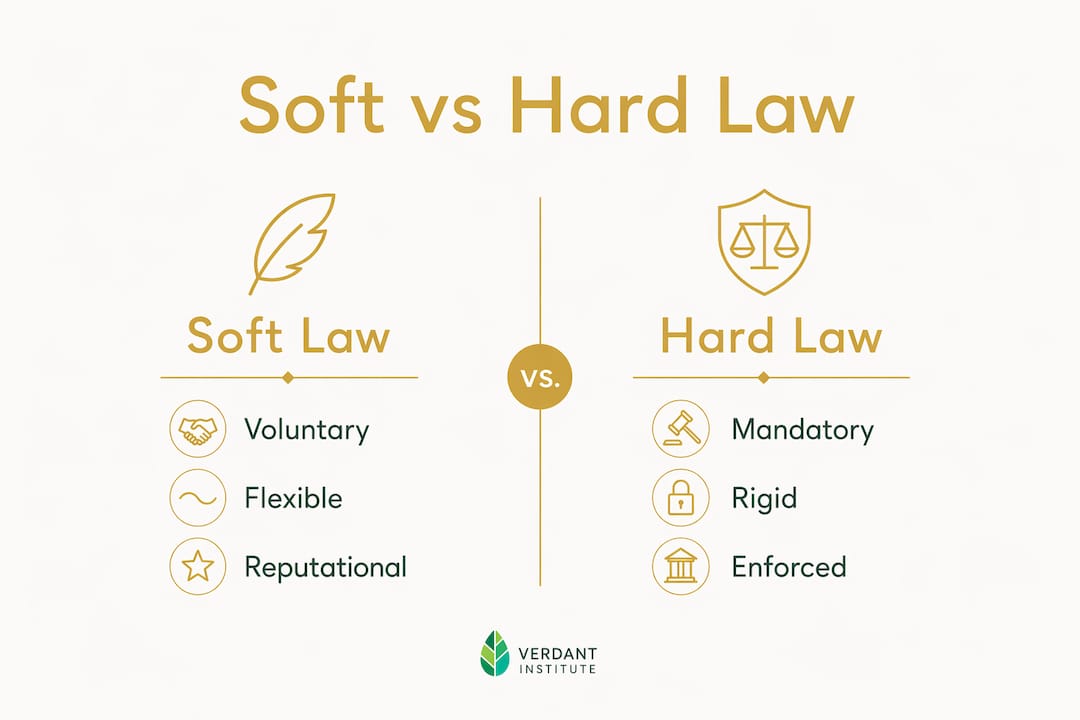
What makes soft law governance particularly complex is its deliberate openness. As legal analysis from Slaughter and May notes, soft law prioritizes participation over precision, leaving key ESG terms intentionally undefined to allow broad adoption across jurisdictions and industries. That flexibility is a feature when building consensus, but it creates real interpretive challenges when companies try to operationalize the concepts.
The sheer volume of voluntary frameworks compounds this. Research on ESG metrics standardization confirms that the heterogeneity of voluntary ESG frameworks creates complexity for firms trying to translate soft law into consistent internal processes. A company operating across multiple jurisdictions may find itself navigating TCFD, GRI, SASB, UNPRI, and the SDGs simultaneously, each with overlapping but non-identical requirements.
Pro Tip: Map your existing ESG reporting against at least three major soft law frameworks before engaging with any new mandatory disclosure regime. The overlap is usually substantial, and identifying gaps early reduces the compliance burden when voluntary standards become law.
The types of ESG disclosure frameworks now in use reflect this layered soft law heritage, and understanding their origins helps practitioners anticipate where mandatory requirements are heading next.
How businesses can manage soft law uncertainty in ESG compliance
The central compliance challenge with soft law is not ignorance of its existence. Most ESG professionals know the major frameworks. The challenge is interpreting loosely defined terms accurately enough to build defensible policies, without overclaiming in ways that create greenwashing exposure.
Take "supply chain due diligence" as an example. The UNGPs and OECD Guidelines both reference it extensively, but neither defines precisely how deep into a supply chain a company must look, what remediation obligations attach to identified risks, or how to document the process. When the EU's CSDD incorporated this concept into binding law, companies that had already built due diligence processes grounded in the soft law originals were far better positioned than those starting from scratch.
Strategies that work in practice:
- Read soft law in context, not isolation. Legal advisers consistently stress that interpreting a single soft law term without understanding its evolution across related instruments produces unreliable conclusions. The OECD Guidelines and UNGPs cross-reference each other deliberately.
- Track the trajectory, not just the current text. Soft law evolves through commentary, case studies, and updated guidance notes. The OECD's National Contact Point decisions, for instance, effectively interpret the Guidelines in real disputes and signal how terms will be applied.
- Build tailor-made ESG policies. Physical risks, litigation risks, and transition risks are company-specific. A policy copied from a peer's sustainability report may not reflect your actual exposure profile or the soft law concepts most relevant to your sector.
- Horizon scan systematically. Professional advisers now spend considerable time engaging directly with initiatives that are creating new soft law instruments, because early visibility into emerging frameworks allows clients to shape their own policies before compliance becomes mandatory.
- Manage greenwashing risk proactively. Communicating ESG progress clearly and accurately is both a competitive advantage and a legal risk management tool. Vague claims tied to loosely defined soft law terms are exactly what regulators and litigants target.
Pro Tip: When drafting external ESG communications, test every claim against the specific soft law instrument it references. If the claim cannot be traced to a defined standard or a documented internal process, it is a greenwashing risk, regardless of intent.
Compliance in a soft law environment also requires understanding that evolving compliance standards across financial regulation increasingly intersect with ESG expectations, particularly in areas like KYC, beneficial ownership, and supply chain transparency.

How soft law hardens into binding ESG regulation
The process by which soft law becomes hard law is well documented in EU corporate sustainability regulation and is accelerating globally. Scholars describe this as "hardening," a multi-phase process in which voluntary norms are progressively integrated into legally binding instruments, with obligations becoming more precisely defined and enforceable at each stage.
The EU's trajectory illustrates this clearly. The European Commission began with non-binding communications defining corporate social responsibility as a voluntary undertaking. Those soft instruments inspired France's Act on New Economic Regulations and later the Non-Financial Reporting Directive, which itself represented a semi-hard intermediate stage. The multilevel hardening of CSR in the EU shows how domestic legislation in member states created pressure for harder EU-level requirements, ultimately producing the Corporate Sustainability Reporting Directive (CSRD) and the CSDD.
The CSDD is the clearest current example of soft law formalized into binding obligation. Its drafting drew directly from the UNGPs, the SDGs, and the OECD Guidelines, incorporating their terminology and conceptual frameworks into mandatory due diligence requirements. Companies that had already built processes around those soft law instruments found the CSDD's requirements familiar. Those that had not faced a steep learning curve.
| Regulatory environment | Example | ESG rating divergence | Enforcement mechanism |
|---|---|---|---|
| Unregulated | USA, China | Highest | None (voluntary frameworks only) |
| Soft law | Japan (Code of Conduct) | Low, comparable to hard law | Voluntary with structured oversight |
| Hard law | Germany (CSRD), India (BRSR) | Lower | Mandatory disclosure, regulatory oversight |
Research comparing ESG rating divergence across five major economies found that unregulated markets like the USA and China show the highest discrepancies between rating agencies, while Japan's structured soft law approach achieves alignment levels comparable to Germany and India's hard law regimes. The key variable is not whether a framework is technically binding, but whether it is consistently enforced and structured enough to reduce information asymmetry.
For US-based practitioners, this has direct implications. The US currently operates without ESG-specific disclosure mandates at the federal level, placing it in the unregulated category alongside China. That means American companies rely heavily on voluntary frameworks like SASB and ISSB standards, with the attendant rating divergence and investor uncertainty that characterizes unregulated markets. The SEC's climate disclosure rulemaking, whatever its eventual form, will draw from exactly the soft law frameworks that have been shaping corporate practice for years.
What advisers and stakeholders do to make soft law work
Soft law does not interpret itself. The gap between a principle in a UN framework and a defensible corporate policy is filled by legal advisers, sustainability consultants, NGOs, and industry bodies who translate abstract norms into operational guidance. Understanding how that translation happens is essential for any professional working in ESG governance.
Legal advisers play several distinct roles:
- Interpretation: Mapping soft law terms against their origins, evolution, and application in analogous contexts to give clients a defensible reading of ambiguous concepts.
- Policy drafting: Translating soft law principles into internal ESG policies, supplier codes of conduct, and board-level governance frameworks that can withstand scrutiny from investors, regulators, and civil society.
- Greenwashing risk management: Reviewing external communications to identify claims that outrun the underlying evidence or rely on undefined soft law terms without adequate qualification.
- Horizon scanning: Monitoring emerging soft law initiatives, regulatory consultations, and judicial decisions that signal where mandatory requirements are heading, so clients can adapt before compliance becomes compulsory.
- Stakeholder engagement: Advising on how to engage constructively with NGOs, investor coalitions, and standard-setting bodies that shape the soft law environment, including responding to OECD National Contact Point complaints.
Stakeholders beyond legal advisers also shape how soft law operates in practice. Institutional investors, particularly those operating under the UNPRI, use their engagement and voting power to push portfolio companies toward soft law compliance. NGOs file complaints under the OECD Guidelines' National Contact Point mechanism, creating reputational and operational pressure that functions as quasi-enforcement even without legal sanctions. The role of NGOs in ESG finance has grown substantially as soft law frameworks have expanded, with civil society organizations increasingly acting as de facto monitors of corporate compliance.
The University of Colorado Law Review's analysis of net-zero pledges captures this dynamic precisely: soft law commitments create public expectations for which companies should anticipate being held accountable, through investor scrutiny, consumer pressure, NGO watchdogs, and media attention, even when no formal legal obligation exists.
What the research shows about soft law's effectiveness and limits
The empirical picture on soft law in ESG is nuanced. Soft law clearly drives adoption of ESG practices and creates a common vocabulary for sustainability governance. But its effectiveness in producing consistent, comparable, and reliable ESG information is demonstrably weaker than hard law with real enforcement.
The most instructive finding from recent cross-country research is Japan's position. Japan applies a soft regulatory approach through its Code of Conduct for ESG Evaluation and Data Providers, introduced in 2022. Despite being voluntary, this structured framework achieves ESG rating alignment comparable to Germany's CSRD and India's BRSR, both of which are mandatory. The lesson is not that soft law is as good as hard law in general. It is that well-structured soft law with genuine institutional backing can approach hard law's effectiveness, while poorly structured voluntary frameworks produce the fragmentation seen in the US market.
The US case is instructive for practitioners here. Without ESG-specific disclosure mandates, American companies face the highest rating divergence among major economies, with Sustainalytics, S&P Global, and Refinitiv producing substantially different assessments of the same companies. That divergence complicates capital allocation, increases the risk of greenwashing claims, and makes it harder for boards to benchmark their ESG performance credibly.
Several structural challenges limit soft law's effectiveness:
- Framework heterogeneity: The proliferation of voluntary ESG standards means companies can choose frameworks that flatter their performance, undermining comparability across the market.
- Enforcement ambiguity: Without penalties for non-compliance, soft law depends on reputational pressure and market incentives, which vary considerably by sector and investor base.
- Crowd regulation: Social media and consumer pressure act as quasi-regulatory forces, creating accountability that formal soft law instruments cannot always anticipate or structure. This "crowd reg" dynamic can be powerful but is also unpredictable and susceptible to campaigns that prioritize visibility over accuracy.
- Signaling without substance: Soft law enables companies to make net-zero pledges and ESG commitments as strategic signals to investors and stakeholders, but the absence of standardized verification means the gap between pledge and performance can be wide.
Research consistently finds that regulatory enforcement, not mere policy announcements, reduces ESG rating divergence. Structured voluntary frameworks can work, as Japan demonstrates, but they require institutional commitment and consistent application to produce the transparency that investors and regulators need.
The ESG controversy scoring methodology used by major rating agencies reflects exactly this problem: when soft law frameworks produce inconsistent disclosures, controversy scores diverge sharply, and the signal value of ESG ratings for investors diminishes.
How soft law changes corporate decision-making and reporting
Soft law reshapes corporate behavior long before it becomes mandatory. The mechanism is straightforward: institutional investors managing trillions in assets have adopted UNPRI commitments and TCFD recommendations as baseline expectations for portfolio companies. When BlackRock, Vanguard, or State Street signal that climate disclosure aligned with TCFD is a condition for continued investment, that is soft law operating through market pressure rather than legal mandate.

The effect on reporting practices has been substantial. Companies that began voluntarily adopting GRI or SASB standards a decade ago now find those frameworks embedded in their internal data systems, governance processes, and board reporting cycles. The voluntary adoption was driven by investor expectations and peer benchmarking, not legal requirements. But the infrastructure built for voluntary compliance is now the foundation for mandatory reporting under the CSRD for EU-exposed companies and increasingly for SEC disclosure requirements in the US.
Board-level governance has shifted too. ESG committees, sustainability officers, and dedicated internal audit functions for non-financial reporting were rare a decade ago. Their proliferation reflects the pressure created by soft law instruments, particularly the UNPRI's stewardship expectations and the TCFD's governance disclosure requirements. The "juridification" of ESG, its transformation from discretionary ethical commitment to structured compliance function, is largely a product of soft law hardening into institutional expectation before it hardens into legal obligation.
Corporate strategy has followed. Net-zero pledges, science-based targets aligned with the Science Based Targets initiative (SBTi), and supply chain human rights policies are all responses to soft law frameworks that have created market expectations with real financial consequences for non-compliance. A company without a credible climate transition plan faces investor engagement, exclusion from ESG indices, and reputational risk, none of which require a court order to materialize.
How enforcement differs between soft law and hard law in ESG
The enforcement gap between soft law and hard law in ESG is the most practically significant distinction for compliance professionals. Hard law carries legal penalties: fines, regulatory sanctions, director liability, and in some jurisdictions, criminal exposure. Soft law carries none of these. Its enforcement relies entirely on non-legal mechanisms, and understanding those mechanisms is essential for calibrating compliance investment.
Soft law enforcement operates through four main channels. Reputational pressure from investors, NGOs, and media creates accountability for companies that publicly adopt soft law frameworks and then fail to follow through. Market consequences, including exclusion from ESG indices, loss of preferred supplier status, and higher cost of capital, translate soft law non-compliance into financial impact. Stakeholder litigation, while technically based on hard law, increasingly uses soft law standards as the benchmark for what constitutes reasonable corporate conduct. And crowd regulation, the social media and consumer pressure dynamic, creates accountability that can move faster and hit harder than formal enforcement.
Hard law enforcement in ESG is more predictable but also more narrowly scoped. The CSRD mandates specific disclosures with defined timelines and audit requirements. India's BRSR applies to listed companies above a threshold size. Germany's Supply Chain Act imposes due diligence obligations with administrative fines for non-compliance. These instruments create clear obligations and clear consequences, which is why they produce lower ESG rating divergence than voluntary frameworks.
The practical implication for US companies is significant. Operating in an unregulated market means soft law is currently the primary governance mechanism for ESG. The reputational and market enforcement channels are real and consequential, but they are also less predictable than statutory obligations. Companies that treat soft law compliance as optional because it lacks legal teeth are misreading the risk environment, particularly given the pace at which soft law norms are moving toward mandatory status in major trading partners.
How to integrate soft law principles into corporate governance structures
Integrating soft law into corporate governance is not a one-time project. It requires building institutional capacity to track, interpret, and operationalize a continuously evolving body of guidance. The companies that do this well treat soft law as a live input to governance rather than a compliance checklist to be reviewed annually.
Practical integration strategies that work:
- Assign ownership at the board level. ESG committees or designated board members with explicit responsibility for soft law monitoring create accountability and ensure that emerging frameworks receive strategic attention before they become mandatory.
- Build a materiality assessment process grounded in soft law. The GRI's double materiality concept and the SASB's industry-specific materiality maps both derive from soft law frameworks. Using them as the basis for materiality assessment aligns internal governance with the standards that regulators and investors reference.
- Develop a soft law registry. Maintain a living document that maps the soft law instruments relevant to your sector and jurisdiction, tracks their evolution, and flags where they are likely to harden into binding requirements. This is the foundation for effective horizon scanning.
- Integrate soft law into supplier and partner governance. External ESG policies, including supplier codes of conduct and partnership agreements, should reference the UNGPs and OECD Guidelines explicitly, both because those frameworks define the expected standard and because doing so positions the company well when supply chain due diligence becomes mandatory.
- Train governance teams on soft law interpretation. The ESG research skills required to navigate voluntary frameworks effectively are distinct from traditional legal compliance skills. Finance and legal professionals need to understand how soft law terms evolve, how they are applied in analogous contexts, and how to translate them into defensible internal processes.
- Align internal controls with soft law reporting expectations. Companies that build their internal audit and control frameworks around TCFD, GRI, or ISSB standards before those frameworks become mandatory create reusable infrastructure that reduces the cost of future compliance.
- Engage with standard-setting processes. Responding to consultations from the ISSB, the GRI, or the OECD is not just a public affairs activity. It gives companies early visibility into where standards are heading and an opportunity to shape the frameworks that will eventually govern their reporting.
The future of ESG governance is a layered architecture in which soft law instruments provide the operational and methodological foundation, de facto standards like ISSB exert global authority through market adoption, and legally binding instruments like the CSRD define the mandatory baseline. Companies that understand this architecture and build governance structures that span all three layers are positioned to manage both current expectations and future requirements without starting from scratch each time a new mandate arrives.
Verdantinstitute's structured learning tracks, including Deep Dives into specific ESG topics and Advanced Practice areas covering transition finance and net-zero strategies, are built precisely for professionals who need to develop this kind of layered competency. The ESG and sustainable finance curriculum covers the full spectrum from foundational soft law instruments to the emerging mandatory frameworks reshaping corporate governance in 2026.

Key Takeaways
Soft law is the primary architecture of ESG governance, and companies that track its evolution gain a measurable compliance advantage when voluntary norms become binding law.
| Point | Details |
|---|---|
| Soft law precedes hard law | Instruments like the UNGPs and OECD Guidelines directly shaped the EU's CSDD, showing how voluntary norms become mandatory obligations. |
| Enforcement is real without legal penalties | Investor pressure, NGO scrutiny, and crowd regulation create accountability for soft law non-compliance with genuine financial consequences. |
| US market faces highest ESG rating divergence | Without ESG-specific mandates, the USA operates in an unregulated environment where rating divergence between agencies is most severe. |
| Japan shows structured soft law can work | Japan's voluntary Code of Conduct achieves ESG rating alignment comparable to Germany's and India's hard law regimes, when consistently applied. |
| Integration requires ongoing institutional capacity | Effective soft law governance demands a living registry, board-level ownership, and staff trained in soft law interpretation, not a one-time compliance review. |