

Intentionality in impact investing means an investor's explicit, documented commitment to generate measurable social or environmental outcomes alongside a financial return. That commitment must exist before capital is deployed, not after. The GIIN defines impact investments as "made with the intention to generate positive, measurable social and/or environmental impact alongside a financial return" — and that word intention is doing serious work. It is not a label you apply retroactively to a portfolio that happened to land in green sectors.
Three things follow from that definition that every practitioner needs to internalize:
- Ex-ante documentation: Intent must be stated in investment policy, fund documents, or a Theory of Change before the first check is written.
- Investor contribution: The investor's capital or active engagement must plausibly change the outcome, not just buy exposure to a company with a good mission.
- Measurement and feedback: Outcomes must be tracked, reported, and used to manage the portfolio toward the stated intent.
Table of Contents
- What does intentionality mean in impact investing, and how does it fit the broader framework?
- What frameworks help you identify and verify genuine intentionality?
- How do you operationalize intentionality inside an investment process?
- Why intentionality alone isn't enough: additionality and investor contribution
- What intentionality is not: common misunderstandings and pitfalls
- How intentionality looks across asset classes
- How do you institutionalize intentionality at the firm level?
- Key Takeaways
- A practitioner's perspective on the real trade-offs
- Verdantinstitute: structured training for impact investment teams
- Sources and further reading
What does intentionality mean in impact investing, and how does it fit the broader framework?
Impact investing rests on four characteristics that practitioners and standard-setters broadly agree on: intentionality, measurement and management, financial return expectations, and investor contribution or additionality. Intentionality is listed first for a reason — without it, you are doing something else, whether that is ESG integration, socially responsible screening, or plain-vanilla investing in a sector that happens to do good.
The GIIN's core characteristics guidance makes clear that intentional investments must be actively managed toward the stated intent, with transparent performance reporting up and down the investment chain. That is a higher bar than most ESG strategies set for themselves.
Where intentionality gets complicated is the spectrum between impact-aligned and impact-generating strategies. An impact-aligned investor buys exposure to companies whose products or services address a social need. An impact-generating investor actively contributes to an outcome that would not have occurred without their specific capital or action. Both can be legitimate, but only the second fully satisfies the GIIN definition.
Intentionality is necessary. It is not sufficient. The moment you treat it as a checkbox rather than an ongoing commitment, you are drifting toward what practitioners call "intentionality washing."
What frameworks help you identify and verify genuine intentionality?
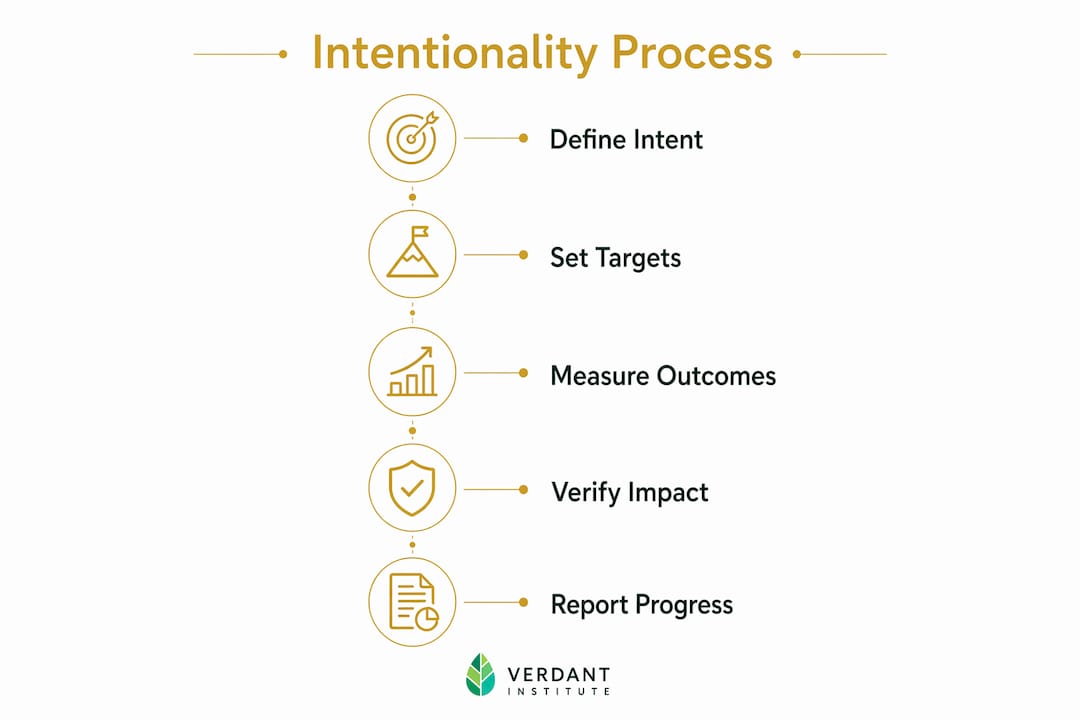
Two frameworks dominate practitioner conversations: the Impact Management Project's five dimensions and the Theory of Change.
The IMP's five dimensions translate investor intent into structured, answerable questions:
- What outcomes does the investment target, and how important are they to the people affected?
- Who experiences the outcome, and are they underserved relative to available alternatives?
- How much change occurs, at what scale, and for how long?
- Contribution: Does the investor's action improve outcomes beyond what would have happened anyway?
- Risk: What is the likelihood that the impact is different from what was intended?
Intentionality maps most directly to the What and Contribution dimensions. If you cannot answer those two with specifics, the intent is aspirational at best.
A Theory of Change (ToC) is the other non-negotiable. GIIN guidance treats a pre-deployment ToC as best practice precisely because it forces the investor to articulate the causal chain from capital input to social outcome before money moves. A ToC written after the fact is a narrative, not a commitment.
Observable signals of genuine intentionality in fund documents include:
- A named impact thesis with specific outcome targets (not just sector exposure)
- Investment committee minutes that reference impact criteria alongside financial criteria
- Incentive structures where carried interest or performance fees are partly tied to impact KPIs
- Explicit language on how the fund will contribute to outcomes (catalytic capital, governance rights, technical assistance)
- A stated baseline and target for at least one primary impact metric
Pro Tip: When reviewing fund documents, search for the phrase "impact risk" alongside "financial risk." A fund that treats impact risk as a managed variable — not just a disclosure — is signaling that intentionality is embedded in its decision process, not bolted on for marketing.
The UN Sustainable Development Goals are widely used as a mapping tool. Linking a fund's thesis to specific SDG targets (say, SDG 3 on health outcomes or SDG 7 on clean energy access) gives a shared vocabulary for reporting, though SDG alignment alone does not prove investor contribution. For a deeper look at how SDGs shape impact strategy, the mapping logic matters as much as the label.

How do you operationalize intentionality inside an investment process?
Stating intent in a fund prospectus is the starting line, not the finish. Here is how investment teams translate that statement into a repeatable process:
- Pre-deal: Draft a one-page Theory of Change. Define the problem, the investor's specific mechanism of action, the expected outcome, and the baseline. Set at least one quantitative target before the investment committee meets.
- Diligence: Assess impact risk and contribution. Ask explicitly whether the outcome depends on the investor's capital or would occur regardless. Document the answer. If the answer is "it would happen anyway," the contribution case is weak.
- Structuring: Embed intentionality in legal documents. Covenants tied to impact KPIs, reporting obligations, and — where the mandate allows — pricing that reflects a concessionary return in exchange for a stronger impact commitment.
- Portfolio management: Build feedback loops. Quarterly or annual KPI reviews that feed back into active engagement with portfolio companies. Impact data should reach the investment committee, not just the impact team.
- Reporting: Communicate transparently. Report outcomes against the ex-ante targets, including shortfalls. Investors who only report wins are not managing toward intent; they are managing perception.
| Impact target | Unit of measurement | Baseline | Target | Reporting cadence |
|---|---|---|---|---|
| People with clean water access | Individuals served per year | — | — | Annual |
| Smallholder farmers trained | Training completions per year | — | — | Semi-annual |
| Renewable energy generated | MWh per year | — | — | Annual |
| Affordable housing units | Units financed | — | — | Annual |
Pro Tip: In investment committee memos, add a standalone "Impact Intentionality" section that states the ToC, the primary KPI, the baseline, and the contribution rationale in four sentences or fewer. If you cannot write it in four sentences, the thesis is not yet clear enough to invest.
Why intentionality alone isn't enough: additionality and investor contribution
Additionality is the test that separates genuine impact investing from impact-aligned exposure. It asks a simple, uncomfortable question: would this outcome have happened without your capital?
SSGA's analysis draws a sharp line between impact investing and what it calls Sustainable Outcome Investing (SOI). SOI applies intentionality and measurement in public markets without claiming investor additionality. That is a legitimate strategy, but it is a different category. Conflating the two is one of the field's most common credibility problems.
MDPI research from 2024 reinforces this: intentionality must be institutionalized to be credible, and investors in impact-first mandates often need to subordinate some financial criteria to prioritize impact. That trade-off is a feature, not a bug. It is what distinguishes a genuine impact mandate from a marketing label.
Practical ways to evidence investor contribution:
- Catalytic capital: Providing first-loss capital or a concessionary tranche that unlocks commercial co-investment that would not otherwise have occurred.
- Active engagement: Using governance rights to push portfolio companies toward specific impact outcomes, documented in board minutes.
- Technical assistance: Deploying non-financial resources (expertise, networks, capacity-building grants) alongside capital.
- Blended finance structures: Combining grant, debt, and equity in ways that de-risk the transaction for commercial investors.
- Covenant-driven outcomes: Structuring loan or equity agreements so that pricing or terms are explicitly tied to achieving stated impact targets.
For a broader look at impact investing strategies that operationalize these contribution mechanisms, the asset-class context matters considerably.
What intentionality is not: common misunderstandings and pitfalls
The most expensive mistake in impact investing is confusing the investee's mission with the investor's intentionality. A fund that invests exclusively in companies with social missions has not demonstrated intentionality. It has demonstrated sector preference.
Common misconceptions, corrected:
- "We invest in ESG-screened companies, so we're doing impact investing." ESG integration assesses how sustainability factors affect financial risk and return. It does not require an explicit intent to generate a specific social outcome. The distinction between impact investing and ESG integration is fundamental, not cosmetic.
- "Our fund is labeled impact, so the intent is established." A label is not a commitment. Without a ToC, ex-ante targets, and documented contribution logic, the label is marketing. This is what practitioners mean by intentionality washing.
- "We invest in green bonds, so we have intentionality." Green bond proceeds must be allocated to eligible projects, and that allocation is a form of intentionality. But the investor's contribution claim depends on whether their participation changed the terms, scale, or feasibility of the project.
- "Impact investing is just philanthropy with a return expectation." Impact investing differs from philanthropy in that it expects a financial return and operates through market mechanisms. Philanthropy does not require additionality in the same sense; impact investing does.
The public versus private market distinction matters here. In private markets, the investor's capital is often genuinely scarce and the contribution case is more direct. In public markets, secondary-market purchases do not provide capital to the company, so the contribution claim must rest on engagement, signaling, or market-pricing effects. Neither is disqualifying, but the evidence requirements are different.
How intentionality looks across asset classes
Intentionality is not an abstraction. Here is what it looks like when it is working:
-
Private growth equity: A fund invests in a rural health technology company with a ToC linking its telemedicine platform to reduced maternal mortality in underserved counties. The term sheet includes a covenant requiring the company to report patient outcomes quarterly, and carried interest is partially contingent on reaching 100,000 active users in Medicaid-eligible populations by Year 4.
-
Concessional credit: A community development financial institution (CDFI) provides a first-loss loan to a small-business lending platform serving minority-owned enterprises in the Southeast. The CDFI's catalytic role unlocks a senior tranche from a commercial bank that would not have participated otherwise. The contribution case is the first-loss position, not just the sector.
-
Public equity (active engagement): An asset manager with a large position in a food and beverage company uses its proxy voting rights and direct engagement to push the company toward reducing added sugar in products sold in low-income markets. The fund's impact report tracks the reformulation timeline and the percentage of revenue from reformulated products — not just the ESG score.
-
Green bonds: A fixed-income portfolio allocates to a municipal green bond financing affordable, energy-efficient housing in Chicago. The fund's intentionality is documented through proceeds allocation reporting, an independent second-party opinion on the bond framework, and annual impact KPIs covering units built and average energy cost savings per household.
Each of these examples shares one feature: the investor's specific action is traceable to a specific outcome. That traceability is the operational definition of intentionality.
How do you institutionalize intentionality at the firm level?
Individual deal-level intent is not enough if the firm's governance does not reinforce it. MDPI's 2024 research points directly to embedded governance and incentives as the most reliable signals that intentionality is genuine rather than performative.
A governance checklist for impact-focused institutions:
- Board oversight: At least one board-level agenda item per year dedicated to impact performance, not just financial performance.
- Investment policy statement: A written IPS that requires a ToC for every new investment and defines minimum impact criteria alongside financial criteria.
- Impact KPIs in performance reviews: Portfolio managers assessed partly on impact outcomes, not only on IRR or AUM growth.
- Remuneration linkage: Where fiduciary rules permit, carried interest or bonuses partially tied to verified impact results.
- Third-party verification: Annual or biennial independent review of impact claims against the ex-ante ToC and stated targets.
Training matters too. Investment teams that have not been trained in impact measurement tend to treat it as a compliance task rather than a portfolio management tool. Capacity-building for investment officers, not just impact specialists, is what makes intentionality durable.
GIIN tools and IMP mapping templates give teams a structured starting point for both documentation and verification. Third-party verification against these standards increases credibility with LPs, regulators, and co-investors who are increasingly skeptical of self-reported impact claims.

Key Takeaways
Intentionality in impact investing requires ex-ante documentation, credible investor contribution, and embedded governance — stated intent without these three elements does not meet the standard the field has set for itself.
| Point | Details |
|---|---|
| Intentionality is ex-ante | Document intent in a Theory of Change and investment policy before capital is deployed, not after. |
| Intent alone is insufficient | Investor contribution and additionality must be demonstrated — would the outcome have occurred without your capital? |
| IMP five dimensions structure the work | Map your ToC to What, Who, How Much, Contribution, and Risk to translate intent into measurable questions. |
| Governance embeds intentionality | Board oversight, impact KPIs in performance reviews, and remuneration linkage are the most reliable signals of genuine commitment. |
| Verdantinstitute builds this capacity | Structured courses in impact measurement, Theory of Change, and sustainable finance governance give investment teams the frameworks to operationalize intentionality. |
A practitioner's perspective on the real trade-offs
The hardest part of intentionality is not writing the Theory of Change. It is defending it when a deal that scores well financially scores poorly on contribution. That tension is where most impact programs quietly compromise. The investment committee approves the deal, the impact team adds a footnote, and the fund's intentionality slowly becomes a marketing exercise.
What actually works is making impact criteria a genuine veto right in the investment process, not an advisory input. That requires resourcing: a dedicated impact function, data systems that can track KPIs across a portfolio, and the budget to commission third-party verification. None of that is free. Funds that treat impact measurement as a cost center rather than a portfolio management tool tend to produce impact reports that are long on narrative and short on numbers.
The other honest note: measurement takes longer than most LPs expect. Outcome data for health, education, or economic mobility interventions often lags by 12–24 months. Staged reporting, with leading indicators in the first year and lagging outcomes in years two and three, is a more credible approach than promising annual outcome data you cannot actually deliver. Realistic expectations, set at the term sheet stage, are part of what intentionality means in practice.
Verdantinstitute: structured training for impact investment teams
Most impact investing teams learn intentionality on the job, which is expensive and inconsistent. Verdantinstitute offers a faster path: structured, CPD-accredited courses built specifically for finance professionals who need to operationalize impact frameworks, not just understand them conceptually.

Three learning tracks map directly to the guidance in this article. The Impact Measurement and Management track covers Theory of Change construction, KPI selection, and outcome reporting. The Governance for Sustainable Finance track addresses investment policy, board oversight, and incentive design. The Foundations in Impact Investing track gives newer team members the definitional grounding — GIIN, IMP, additionality — that makes the advanced material land. Institutional licensing is available for teams that want to train an entire investment committee or impact function under one agreement. Individual subscriptions start at $18/month for students and $58/month for professionals.
If your team is building or auditing an impact program, explore Verdantinstitute's course library and see which tracks fit your current gaps.
Sources and further reading
- GIIN — Core Characteristics of Impact Investing: The canonical source for the four core characteristics, including the definition of intentionality and the requirement for ex-ante documentation and transparent reporting.
- GIIN — What You Need to Know About Impact Investing: A broader primer on impact investment meaning, financial return expectations, and the diversity of strategies that qualify.
- SSGA — Impact Investing vs. Sustainable Outcome Investing: Detailed analysis of how intentionality, contribution, and measurement interact, and why additionality is the key distinguishing tenet.
- MDPI — Intentionality and Decision-Making in Impact Investing (2024): Practitioner-interview-based research on how institutionalized intentionality and governance structures separate credible impact programs from performative ones.
- NAB — Definition of Impact Investing: National Advisory Board guidance on ex-ante intent as a fund-level requirement, useful for teams building or auditing investment policy statements.
- TII Project — Effective Investing for the Long Term (2017): Describes systems-level tools of intentionality including additionality, standards-setting, and evaluation frameworks.
- Impact Management Project (IMP) — Five Dimensions Framework: The IMP's What, Who, How Much, Contribution, and Risk dimensions are the most widely used practitioner tool for translating intent into structured measurement. Access templates and mapping tools at impactmanagementproject.com.